

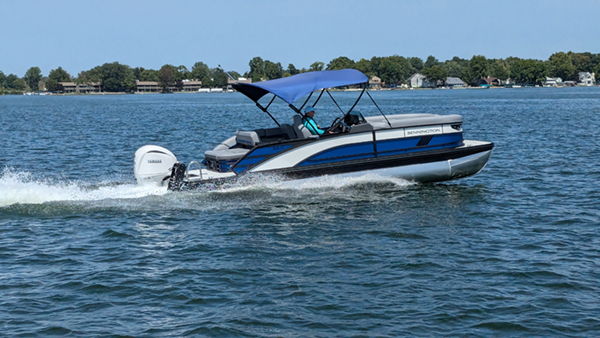
One of the biggest decisions new boat buyers face is selecting the right outboard for their boat. Sometimes builders can make this choice challenging by offering lots of options. Say you’re looking at a 24-foot Bennington M-Series with the ESP+ triple tube package. There are 32 Yamaha choices on its Build a Boat feature, ranging from a 9.9 hp outboard all the way to a 350 hp model. Why on earth would anyone get a 9.9-horsepower engine for a 24-foot pontoon boat? They might if their lake were restricted to engines less than 10 horsepower. Is 350 hp too much? Not if you plan to have a dozen people on board and want to participate in watersports. The point is that many variables need to be considered when choosing an outboard; there is no right answer for everyone.
The Price of More Horsepower
The first and most obvious consideration of engine choice is affordability. Higher-horsepower engines cost more money. If a larger engine puts a boat above your budget, that one should be ruled out. But if more horsepower is needed to push the boat in a way that meets your needs and performance expectations, perhaps the boat choice isn’t a good match. Sometimes, builders will offer a boat package with a smallish engine to meet a low nationally advertised MSRP, which might be fine for those who boat with three or fewer people but may be far underpowered for those who bring along more friends.
Keep in mind that the largest price jumps occur when moving from one engine platform to another. For instance, going from a Yamaha F70 to an F75 might seem like an incremental step up, but the F70 is an inline-four-cylinder (I-4) with a 1.0-liter engine block, also used on the F50 and F60, while the F75 is a 1.8L I-4, also used on the F90 and F115. Likewise, an F150/F200 has a 2.8L I-4 powerhead while the F225/F250/F300 is a V6 with 4.2L of displacement. Using Bennington as an example, adding 75 horsepower when upgrading from an F225 to an F300 costs just $3,295, while going from an F150 to an F225 costs $11,534 more. Typically, choosing the highest horsepower model within an engine platform offers the most bang for the buck.
What Type of Hull is it Powering?
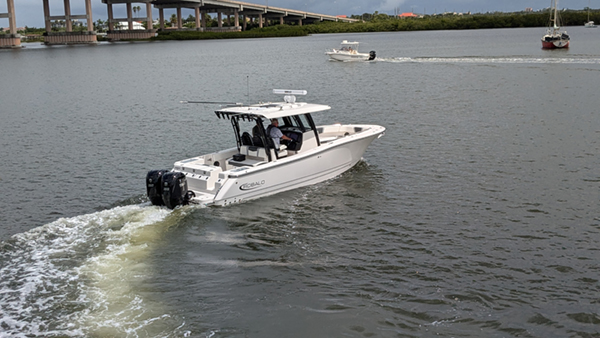
Generally speaking, a boat with a flatter hull bottom, like a skiff, requires less power to perform satisfactorily. That’s because its hull provides more lift to allow it to reach plane more easily. But inshore boats with flatter hulls have more frictional drag, which keeps top speeds lower. Boats designed to go offshore tend to have more deadrise, which is the hull’s angle at the stern. These deep-V boats require more power to get on plane. Boat brands like Regulator are known for their smooth ride in rough conditions, and most of their center console models have a 24-degree deadrise, which is on the upper end and needs more powerful outboards to operate properly. Bay boats typically feature 16-18-degree deadrise hulls, allowing them to traverse shallower water without touching bottom, requiring less power than offshore models.
How Much Weight is it Carrying?
More weight in a boat hull pushes it farther down into the water, requiring more power to get it on plane and keep it there. Not only does carrying more people create a need for more power, but other factors should also be considered. Many fishing boats have large livewells that can greatly increase the weight, and their placement also matters. A full 40-gallon livewell on the transom weighs 342 pounds. And with that much weight aft, it makes it harder for the bow to drop, so a fully-loaded boat can’t reach plane quickly unless it has plenty of power. A boat with a large gas tank also requires more power. A full 200-gallon fuel tank weighs 1,220 pounds, which can put underpowered boats at a huge disadvantage.
Dealer Advice
One of the best resources for choosing the right engine for your boat that hits the sweet spot of performance/price is a trusted dealer. The best outboard choice depends on how you use your boat, and a knowledgeable dealer can help identify the package that best fits your lifestyle, performance needs, and budget.” One of the most valuable things to know is which engine package is purchased most often, and dealers can usually provide a percentage of buyers who purchased a specific power level.
Performance
Several aspects of performance differ, and knowing which is most important to a boater’s intended use is valuable information. Top-end performance is one benchmark to consider. While some boaters strive to have the fastest boat for mere bragging rights, those who fish in tournaments need the most speed possible to beat competitors to hotspots or give anglers the ability to fish in places their fellow anglers can’t reach and still make it back in time for the weigh-in. Others who fish recreationally and don’t have long runs to the action have a less pressing need for a fast boat. While boat operators should always keep an eye on the weather, sometimes a thunderstorm cell can pop up out of nowhere and having the speed to rush to safety is a good ace to have up your sleeve.
How much speed does a recreational boat need? For most applications, except for twin-tube pontoon boats, dedicated ski boats and smaller boats, any boat that can’t crack the 40 mph mark is probably underpowered. Most builders these days try to create packages that can meet the 50 mph threshold, which is a good, general yardstick for identifying boats that aren’t underpowered. Out-of-the-hole performance is another benchmark and is one of the most valuable to consider when buying a flats boat or bay boat intended to run in shallow water. Here, choosing the best model is trickier because more powerful, heavier engines might plane more slowly than lighter models with less horsepower. Acceleration can also be improved by choosing a propeller with less pitch, but this also reduces top speed and can lead to overrevving if taken to extremes.
Excellent throttle response in rough conditions is an important consideration for those who head offshore and may encounter larger waves. Instant-on acceleration is especially important for those also carrying close to maximum loads. Outboards with more horsepower give drivers more control in situations like when a squall hits offshore, or the boat is entering an inlet with an outgoing tide and strong opposing wind and waves.
Sometimes extra horsepower provides an incremental performance improvement, other times, it’s a quantum leap.
Resale Value
While going with a smaller engine package might save money up front, an owner might lose even more when it comes time to sell or trade. Used boat buyers have many choices, and when comparing two boats of the same model, most will choose the higher-horsepower option over boats with the minimum power. Often, a seller will have to steeply discount the price to generate interest in a boat with a lower-horsepower outboard. Check used boat websites to see how an engine choice affects resale value.
Where to Find Performance Data
One of the best resources for seeing how boats with different power levels perform is the Yamaha Outboards website under Owner Resources/Performance Bulletins, which features hundreds of tests conducted by Yamaha technicians. Not only will these tests show acceleration and fuel efficiency data, but they are also a great resource for information on boat setup and prop choice. Often, there are tests on the same boat model with different engines, which helps an owner choose the package that makes the most sense for their lifestyle. Take, for example, the two tests of a Cobia 240 CC: one with twin Yamaha F150s and another with a single F300. Another source of information is online reviews performed by reputable magazines and websites.
Fuel Economy
Some owners are surprised to learn that adding more horsepower doesn’t always cost them more at the pump. Comparing a pair of Pathfinder 2800 Hybrids, one with twin Yamaha F250s and another with twin F300 outboards. Because these outboards share the same 4.2L V6 engine block, their fuel economy at cruising speeds, when equipped with the same props, is nearly identical, since the higher horsepower only reveals itself at higher rpm and when the power lever is maxed out during high-performance holeshots.
Available Technology
Sometimes, choosing a larger outboard makes sense to access more advanced technology, like going with a Yamaha F150 over an F115 to get a model that has an integrated electric steering system. Digital Electric Steering (DES) not only does away with hydraulic lines and a tank, but is also quieter, more responsive and compatible with Yamaha’s Helm Master EX, which offers joystick control plus a suite of FishPoint and DriftPoint features, plus the StayPoint virtual anchor feature on twin-engine installations. Choosing the right outboard involves considering all aspects of real-world usage. But keep in mind that the worst mistake is underpowering a boat rather than the alternative. An underpowered boat is a mistake that reminds the owner of their failed choice every time they step onboard. So, when in doubt, choose the higher-horsepower option because one thing you’ll never say is, “I wish I didn’t have all this power.”
Back to Blue Life
The Price of More Horsepower
The first and most obvious consideration of engine choice is affordability. Higher-horsepower engines cost more money. If a larger engine puts a boat above your budget, that one should be ruled out. But if more horsepower is needed to push the boat in a way that meets your needs and performance expectations, perhaps the boat choice isn’t a good match. Sometimes, builders will offer a boat package with a smallish engine to meet a low nationally advertised MSRP, which might be fine for those who boat with three or fewer people but may be far underpowered for those who bring along more friends.
Keep in mind that the largest price jumps occur when moving from one engine platform to another. For instance, going from a Yamaha F70 to an F75 might seem like an incremental step up, but the F70 is an inline-four-cylinder (I-4) with a 1.0-liter engine block, also used on the F50 and F60, while the F75 is a 1.8L I-4, also used on the F90 and F115. Likewise, an F150/F200 has a 2.8L I-4 powerhead while the F225/F250/F300 is a V6 with 4.2L of displacement. Using Bennington as an example, adding 75 horsepower when upgrading from an F225 to an F300 costs just $3,295, while going from an F150 to an F225 costs $11,534 more. Typically, choosing the highest horsepower model within an engine platform offers the most bang for the buck.
What Type of Hull is it Powering?
Generally speaking, a boat with a flatter hull bottom, like a skiff, requires less power to perform satisfactorily. That’s because its hull provides more lift to allow it to reach plane more easily. But inshore boats with flatter hulls have more frictional drag, which keeps top speeds lower. Boats designed to go offshore tend to have more deadrise, which is the hull’s angle at the stern. These deep-V boats require more power to get on plane. Boat brands like Regulator are known for their smooth ride in rough conditions, and most of their center console models have a 24-degree deadrise, which is on the upper end and needs more powerful outboards to operate properly. Bay boats typically feature 16-18-degree deadrise hulls, allowing them to traverse shallower water without touching bottom, requiring less power than offshore models.
How Much Weight is it Carrying?
More weight in a boat hull pushes it farther down into the water, requiring more power to get it on plane and keep it there. Not only does carrying more people create a need for more power, but other factors should also be considered. Many fishing boats have large livewells that can greatly increase the weight, and their placement also matters. A full 40-gallon livewell on the transom weighs 342 pounds. And with that much weight aft, it makes it harder for the bow to drop, so a fully-loaded boat can’t reach plane quickly unless it has plenty of power. A boat with a large gas tank also requires more power. A full 200-gallon fuel tank weighs 1,220 pounds, which can put underpowered boats at a huge disadvantage.
Dealer Advice
One of the best resources for choosing the right engine for your boat that hits the sweet spot of performance/price is a trusted dealer. The best outboard choice depends on how you use your boat, and a knowledgeable dealer can help identify the package that best fits your lifestyle, performance needs, and budget.” One of the most valuable things to know is which engine package is purchased most often, and dealers can usually provide a percentage of buyers who purchased a specific power level.
Performance
Several aspects of performance differ, and knowing which is most important to a boater’s intended use is valuable information. Top-end performance is one benchmark to consider. While some boaters strive to have the fastest boat for mere bragging rights, those who fish in tournaments need the most speed possible to beat competitors to hotspots or give anglers the ability to fish in places their fellow anglers can’t reach and still make it back in time for the weigh-in. Others who fish recreationally and don’t have long runs to the action have a less pressing need for a fast boat. While boat operators should always keep an eye on the weather, sometimes a thunderstorm cell can pop up out of nowhere and having the speed to rush to safety is a good ace to have up your sleeve.
How much speed does a recreational boat need? For most applications, except for twin-tube pontoon boats, dedicated ski boats and smaller boats, any boat that can’t crack the 40 mph mark is probably underpowered. Most builders these days try to create packages that can meet the 50 mph threshold, which is a good, general yardstick for identifying boats that aren’t underpowered. Out-of-the-hole performance is another benchmark and is one of the most valuable to consider when buying a flats boat or bay boat intended to run in shallow water. Here, choosing the best model is trickier because more powerful, heavier engines might plane more slowly than lighter models with less horsepower. Acceleration can also be improved by choosing a propeller with less pitch, but this also reduces top speed and can lead to overrevving if taken to extremes.
Excellent throttle response in rough conditions is an important consideration for those who head offshore and may encounter larger waves. Instant-on acceleration is especially important for those also carrying close to maximum loads. Outboards with more horsepower give drivers more control in situations like when a squall hits offshore, or the boat is entering an inlet with an outgoing tide and strong opposing wind and waves.
Sometimes extra horsepower provides an incremental performance improvement, other times, it’s a quantum leap.
Resale Value
While going with a smaller engine package might save money up front, an owner might lose even more when it comes time to sell or trade. Used boat buyers have many choices, and when comparing two boats of the same model, most will choose the higher-horsepower option over boats with the minimum power. Often, a seller will have to steeply discount the price to generate interest in a boat with a lower-horsepower outboard. Check used boat websites to see how an engine choice affects resale value.
Where to Find Performance Data
One of the best resources for seeing how boats with different power levels perform is the Yamaha Outboards website under Owner Resources/Performance Bulletins, which features hundreds of tests conducted by Yamaha technicians. Not only will these tests show acceleration and fuel efficiency data, but they are also a great resource for information on boat setup and prop choice. Often, there are tests on the same boat model with different engines, which helps an owner choose the package that makes the most sense for their lifestyle. Take, for example, the two tests of a Cobia 240 CC: one with twin Yamaha F150s and another with a single F300. Another source of information is online reviews performed by reputable magazines and websites.
Fuel Economy
Some owners are surprised to learn that adding more horsepower doesn’t always cost them more at the pump. Comparing a pair of Pathfinder 2800 Hybrids, one with twin Yamaha F250s and another with twin F300 outboards. Because these outboards share the same 4.2L V6 engine block, their fuel economy at cruising speeds, when equipped with the same props, is nearly identical, since the higher horsepower only reveals itself at higher rpm and when the power lever is maxed out during high-performance holeshots.
Available Technology
Sometimes, choosing a larger outboard makes sense to access more advanced technology, like going with a Yamaha F150 over an F115 to get a model that has an integrated electric steering system. Digital Electric Steering (DES) not only does away with hydraulic lines and a tank, but is also quieter, more responsive and compatible with Yamaha’s Helm Master EX, which offers joystick control plus a suite of FishPoint and DriftPoint features, plus the StayPoint virtual anchor feature on twin-engine installations. Choosing the right outboard involves considering all aspects of real-world usage. But keep in mind that the worst mistake is underpowering a boat rather than the alternative. An underpowered boat is a mistake that reminds the owner of their failed choice every time they step onboard. So, when in doubt, choose the higher-horsepower option because one thing you’ll never say is, “I wish I didn’t have all this power.”
Back to Blue Life