

What Boat Trim Does
Most boaters know that on every outboard or sterndrive-powered boat, there’s a button on the throttle that allows drivers to change the angle of the outboard in relation to the transom. Pushing the down part of the button brings the lower unit closer to the transom, which also lowers the bow when running. So when talking about trim, down and in mean the same thing. Conversely, pushing the button up moves the outdrive outward and raises the bow, so up and out are also synonymous.
An important thing to know is that most boat transoms have what is called a negative angle, which means they are tilted around 14 degrees, on average, with the top of the transom positioned farther back than the lower part of the transom. This angle helps direct the engine’s thrust upward when trimmed in, which pushes the bow down for quicker planing with reduced bowrise. In addition, Yamaha outboards can trim in 3 or 4 degrees past vertical, depending on the model, which may help the boat get on plane more quickly.
Why Trim Matters
We’ve all seen boats on the water that seem to be running at an odd angle; either the bow is
too low or high. Both situations mean the hull isn’t operating at its best, costing the owner money at the gas pump and making its performance suffer.
Common Trim Mistakes Boaters Make
A sure sign of a new boat owner who doesn’t understand trim is a boat running bow-down while plowing up an impressive bow wake.
Another mistake that even experienced boaters sometimes make is when pulling a boat off plane, like when going through a no-wake zone, they forget to trim the engine down. Then, when it’s time to go faster again, they jam the throttle and the bow pops an embarrassing “wheelie” and the boat fails to get on plane. The moral of the story is to make it a habit to trim down whenever the boat slows down, and before every hole shot, the driver should bump the trim down until they hear a different-pitched sound, indicating it’s fully trimmed in.
The most common trim mistake boat drivers make is trimming the engine all the way down when moving at idle or when docking. Because of the negative transom angle and added negative engine trim, the prop is pointed up at an angle, which pushes the rear of the boat up when in forward and makes the transom dig in and squat when in reverse. Outboards like Yamahas have the lettering on the engine cowling aligned parallel with the prop shaft, so use it to see when the engine is level, which is its most efficient angle of attack at slow speeds.
How to find the Trim Sweet Spot
One of the easiest ways to tell if a boat is trimmed up enough is by how the steering feels. If it’s hard to turn the wheel, it’s likely not trimmed up enough. When the driver starts trimming up, there will be that magic moment when the steering gets lighter, and the boat seems to lift off. Another indicator of proper trim is when the spray coming off the hull moves farther back. For many boats, when the spray is around the helm or the middle of the boat, it is in the happy-trim zone.
Most boats have trim gauges that drivers use to know precisely the state of trim. Knowing where a boat likes the trim set at various speeds based on the indicator position on the gauge makes it quicker to dial in the trim and easier to tell less experienced “guest drivers” how high to set it.
How Trim Affects Fuel Economy and Speed
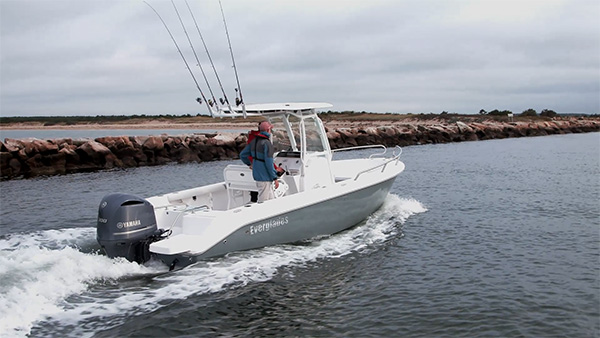
In most cases, the more the hull is contacting the water, the greater the friction, which is the enemy of fuel efficiency and speed. When running, trimming the outboard up lifts the bow and reduces the hull’s wetted surface, so a 30-foot-long hull might have only 20 feet or less of its length touching the water. Boats such as high-performance bass boats take this to the extreme with flatter areas on the back of the hull bottom called planing pads. They allow the driver to trim the motor up until it balances on this running surface, which might be as small as a large pizza, to achieve speeds that can surpass 80 mph.
Modern boat engines have internal computers and sensing devices that precisely measure the amount of fuel burned and can interface with the speedometer to show the driver its fuel economy, expressed in miles per gallon. This information is extremely valuable when trimming a boat. To achieve peak fuel economy at various speeds, all the driver has to do is start trimming the engine up while watching the mpg number climb. There will come a point when the number starts dropping as the prop loses grip when too much air gets in the path of the prop. Then, all the driver has to do is trim down slightly to where the mpg number was at its peak.
Trim vs. Jack Plate Explained
While engine up-trim can be used to reduce draft at idle, when going slightly faster, the draft actually increases. Jack plates raise the engine vertically, which reduces draft and is commonly used when on plane to cross shallow water without disturbing the sea floor.
Keep in mind that steering effectiveness is reduced when the jack plate is at its highest, and it can sometimes feel like a car driving on ice. The same thing happens when engine trim is at its highest. So when driving a boat in places where crisp turns are needed, like on a twisty river or when there are lots of other boats and obstructions like crab trap buoys, don’t raise the engine to its maximum level. If your boat doesn’t have a jack plate, trim down just a little more than you would when going for maximum fuel economy and speed. Then, test the steering to make sure it’s responsive enough.
How to Trim in Rough Water
New boat drivers often mistakenly assume that when running into larger waves, they should raise the bow to give it more clearance to make sure a wave doesn’t come aboard uninvited. Actually, the opposite is true. Most modern planing hull designs have variable deadrise hulls, which feature a sharper angle toward the bow and a flatter angle toward the stern. When heading into larger waves, drivers can use this geometry to their advantage by trimming the engine down a little to lower the bow and use the sharper hull angle to slice through the wave rather than bashing against the flatter part of the hull’s mid-section. Skillful throttle control allows the boat to climb over oncoming waves without launching off the top. If the waves are small enough, a driver can use enough speed to stay on top of the waves, which is normally a smoother, drier ride than creeping along.
Running the same direction as large waves can be potentially more dangerous because when cresting over the top or being overtaken by a wave, it lifts the stern and can stuff the bow into the trough or the back of the wave in front.
The best defense is to trim up a little and use throttle control to stay behind large waves, only crossing over when they are small enough to navigate safely.
How to Trim While Towing Tubers
The primary goal for towing kids of all ages on tubes is safety, which means going no faster than 20 mph, according to the Water Sports Industry Association. But to create enough fun to keep it interesting, instead of using speed, the best strategy is to drive so the tube crosses the wake frequently. This maneuver means the driver will be turning constantly. First, trim the engine all the way down to get on plane smoothly, making sure the tow rope is tight before takeoff. Then, bump the trim up until the steering gets a little lighter, which takes the strain off the motor and increases fuel economy. If the steering isn’t responsive, it’s trimmed up too far.
Trim Assist
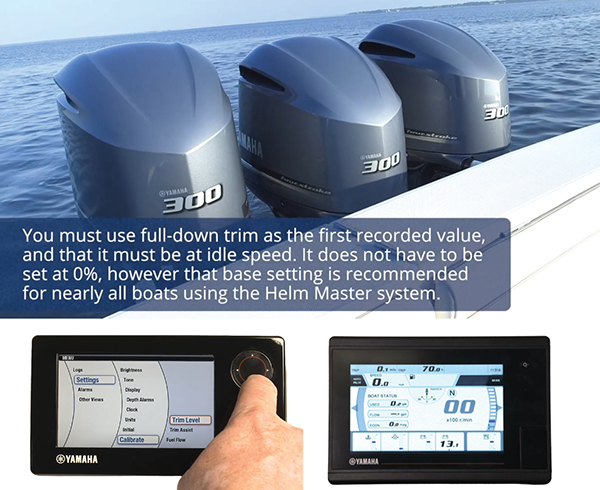
For boats with Yamaha Helm Master EX, a feature called Trim Assist automatically adjusts the trim to the optimum level. To activate it, press the Trim Assist button on the base of the throttle, or turn it on via one of the approved touchscreens. Owners can set the desired trim levels for five different GPS speeds or engine rpm, and when the boat reaches them, the trim automatically adjusts. Many boat manufacturers can provide recommended trim levels for specific models and engine combinations that can be directly entered. This level of automation means the driver can concentrate on other things or can turn the driving over to a less experienced boater without micromanaging them.
Keeping your boat in proper trim not only saves money but also allows owners to enjoy their boat’s maximum performance and handling.
Back to Blue Life
Most boaters know that on every outboard or sterndrive-powered boat, there’s a button on the throttle that allows drivers to change the angle of the outboard in relation to the transom. Pushing the down part of the button brings the lower unit closer to the transom, which also lowers the bow when running. So when talking about trim, down and in mean the same thing. Conversely, pushing the button up moves the outdrive outward and raises the bow, so up and out are also synonymous.
An important thing to know is that most boat transoms have what is called a negative angle, which means they are tilted around 14 degrees, on average, with the top of the transom positioned farther back than the lower part of the transom. This angle helps direct the engine’s thrust upward when trimmed in, which pushes the bow down for quicker planing with reduced bowrise. In addition, Yamaha outboards can trim in 3 or 4 degrees past vertical, depending on the model, which may help the boat get on plane more quickly.
Why Trim Matters
We’ve all seen boats on the water that seem to be running at an odd angle; either the bow is
too low or high. Both situations mean the hull isn’t operating at its best, costing the owner money at the gas pump and making its performance suffer.
Common Trim Mistakes Boaters Make
A sure sign of a new boat owner who doesn’t understand trim is a boat running bow-down while plowing up an impressive bow wake.
Another mistake that even experienced boaters sometimes make is when pulling a boat off plane, like when going through a no-wake zone, they forget to trim the engine down. Then, when it’s time to go faster again, they jam the throttle and the bow pops an embarrassing “wheelie” and the boat fails to get on plane. The moral of the story is to make it a habit to trim down whenever the boat slows down, and before every hole shot, the driver should bump the trim down until they hear a different-pitched sound, indicating it’s fully trimmed in.
The most common trim mistake boat drivers make is trimming the engine all the way down when moving at idle or when docking. Because of the negative transom angle and added negative engine trim, the prop is pointed up at an angle, which pushes the rear of the boat up when in forward and makes the transom dig in and squat when in reverse. Outboards like Yamahas have the lettering on the engine cowling aligned parallel with the prop shaft, so use it to see when the engine is level, which is its most efficient angle of attack at slow speeds.
How to find the Trim Sweet Spot
One of the easiest ways to tell if a boat is trimmed up enough is by how the steering feels. If it’s hard to turn the wheel, it’s likely not trimmed up enough. When the driver starts trimming up, there will be that magic moment when the steering gets lighter, and the boat seems to lift off. Another indicator of proper trim is when the spray coming off the hull moves farther back. For many boats, when the spray is around the helm or the middle of the boat, it is in the happy-trim zone.
Most boats have trim gauges that drivers use to know precisely the state of trim. Knowing where a boat likes the trim set at various speeds based on the indicator position on the gauge makes it quicker to dial in the trim and easier to tell less experienced “guest drivers” how high to set it.
How Trim Affects Fuel Economy and Speed
In most cases, the more the hull is contacting the water, the greater the friction, which is the enemy of fuel efficiency and speed. When running, trimming the outboard up lifts the bow and reduces the hull’s wetted surface, so a 30-foot-long hull might have only 20 feet or less of its length touching the water. Boats such as high-performance bass boats take this to the extreme with flatter areas on the back of the hull bottom called planing pads. They allow the driver to trim the motor up until it balances on this running surface, which might be as small as a large pizza, to achieve speeds that can surpass 80 mph.
Modern boat engines have internal computers and sensing devices that precisely measure the amount of fuel burned and can interface with the speedometer to show the driver its fuel economy, expressed in miles per gallon. This information is extremely valuable when trimming a boat. To achieve peak fuel economy at various speeds, all the driver has to do is start trimming the engine up while watching the mpg number climb. There will come a point when the number starts dropping as the prop loses grip when too much air gets in the path of the prop. Then, all the driver has to do is trim down slightly to where the mpg number was at its peak.
Trim vs. Jack Plate Explained
While engine up-trim can be used to reduce draft at idle, when going slightly faster, the draft actually increases. Jack plates raise the engine vertically, which reduces draft and is commonly used when on plane to cross shallow water without disturbing the sea floor.
Keep in mind that steering effectiveness is reduced when the jack plate is at its highest, and it can sometimes feel like a car driving on ice. The same thing happens when engine trim is at its highest. So when driving a boat in places where crisp turns are needed, like on a twisty river or when there are lots of other boats and obstructions like crab trap buoys, don’t raise the engine to its maximum level. If your boat doesn’t have a jack plate, trim down just a little more than you would when going for maximum fuel economy and speed. Then, test the steering to make sure it’s responsive enough.
How to Trim in Rough Water
New boat drivers often mistakenly assume that when running into larger waves, they should raise the bow to give it more clearance to make sure a wave doesn’t come aboard uninvited. Actually, the opposite is true. Most modern planing hull designs have variable deadrise hulls, which feature a sharper angle toward the bow and a flatter angle toward the stern. When heading into larger waves, drivers can use this geometry to their advantage by trimming the engine down a little to lower the bow and use the sharper hull angle to slice through the wave rather than bashing against the flatter part of the hull’s mid-section. Skillful throttle control allows the boat to climb over oncoming waves without launching off the top. If the waves are small enough, a driver can use enough speed to stay on top of the waves, which is normally a smoother, drier ride than creeping along.
Running the same direction as large waves can be potentially more dangerous because when cresting over the top or being overtaken by a wave, it lifts the stern and can stuff the bow into the trough or the back of the wave in front.
The best defense is to trim up a little and use throttle control to stay behind large waves, only crossing over when they are small enough to navigate safely.
How to Trim While Towing Tubers
The primary goal for towing kids of all ages on tubes is safety, which means going no faster than 20 mph, according to the Water Sports Industry Association. But to create enough fun to keep it interesting, instead of using speed, the best strategy is to drive so the tube crosses the wake frequently. This maneuver means the driver will be turning constantly. First, trim the engine all the way down to get on plane smoothly, making sure the tow rope is tight before takeoff. Then, bump the trim up until the steering gets a little lighter, which takes the strain off the motor and increases fuel economy. If the steering isn’t responsive, it’s trimmed up too far.
Trim Assist
For boats with Yamaha Helm Master EX, a feature called Trim Assist automatically adjusts the trim to the optimum level. To activate it, press the Trim Assist button on the base of the throttle, or turn it on via one of the approved touchscreens. Owners can set the desired trim levels for five different GPS speeds or engine rpm, and when the boat reaches them, the trim automatically adjusts. Many boat manufacturers can provide recommended trim levels for specific models and engine combinations that can be directly entered. This level of automation means the driver can concentrate on other things or can turn the driving over to a less experienced boater without micromanaging them.
Keeping your boat in proper trim not only saves money but also allows owners to enjoy their boat’s maximum performance and handling.
Back to Blue Life