

A little bit of research and strategy goes a long way to creating the ideal day on the water. For a successful outing, planning is everything, especially for boaters in new locations or new boaters. With some research and a good game plan, an outing can be memorable and stress-free, and that’s what boating is all about.
What’s the Plan?
While an outing shouldn’t resemble a military maneuver or have an inflexible itinerary, it’s a good idea to have a general plan. While some boating activities can be done anytime, others are more time dependent. If fishing is on the agenda, the best time is usually in the morning, but in saltwater, the tide may be more favorable at other times. If heading to a popular restaurant on the weekend is on the agenda, available dockage could be a problem, so getting there just as they open or right before might be the best time to arrive. Heading to a sandbar? If it’s a small space, getting there early might be a good idea, but it’s usually better to go when the sun is higher, so you can read the bottom better and get a feel for which boating neighbors are a better fit for your vibe. Take the time to plan an itinerary and decide when to do each activity.
Use Technology to Help Plan an Outing
One of the first things to research is the weather forecast, and one possible source is the free website wunderground.com. Just type in a location and a wealth of weather information becomes available. Start with the hourly forecast to see what the wind speed is forecast to blow and in what direction throughout the day. If it’s calm early, that’s a good time for watersports. This information will also help you decide on an anchorage and inform you as to when adverse weather might arrive. The WunderMap tab shows the local radar and the direction rain and more dangerous weather are heading. Just untick the weather station tab to clean up the screen, then click the radar tab and select the 5x speed tab to show the radar return over the last 45 minutes.
For updates on the water, you might try the WeatherBug app. It’s free with ads, but the Pro version is $10.99 a year or $1.99 a month and is well worth it. Its best feature is that when you open it, it immediately homes in on your location and shows how close the nearest lightning is, without having to navigate further. Click on the radar display to see the latest return and a storm’s intensity and direction of travel. It also has excellent forecast information.
Windy.com is another website/app that can help you find out about current marine conditions, including wave height, direction and duration. It also has excellent tide charts on the premium version. It shows most of the information on color-coded, animated graphic maps to quickly convey it.
The best free tide app is My Tide Times, and, like all the other apps, it can be found on Google Play for Android users or the App Store for those with iPhones.
How to Find Local Information
These days, finding the best local information is as easy as Googling, “Where are the best places to boat and anchor on (insert name)?” Or “Best waterfront restaurants with docks on…” Then connect with the suggested links to dive deeper into the information. eLocal marinas are an excellent source of information on where to go, what to do and where to avoid.
One of the best all-in-one apps is Wavve Boating, which turns your smartphone into a detailed chartplotter with sophisticated navigational aids. It offers extensive information on the best anchorages and sights on many bodies of water in the United States (check their coverage map). The fully-featured app is a bit pricy at $70 a year, but if your boat doesn’t have a chartplotter and you need local intel, it’s worth it. There’s a 14-day free trial, and the free version offers a wealth of information.
What to Consider When Anchoring
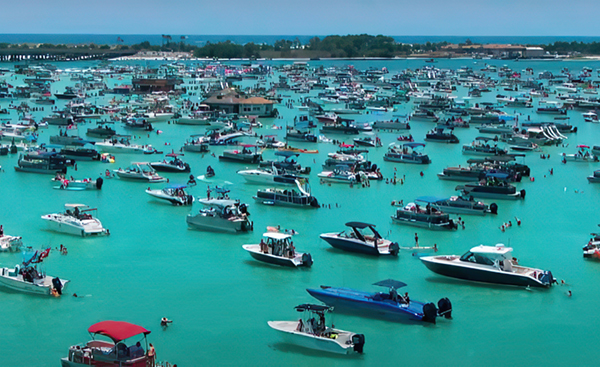
If your itinerary includes anchoring, there are several considerations to keep in mind. In general, the most relaxing anchorages are those out of the way that offer some privacy. First, make sure the spot is not restricted. Dropping an anchor in a narrow channel is not only annoying and dangerous because of the constant traffic, but it might also attract the attention of the marine patrol, which is always a mood-buster. Some locations might be legal, but they’re in areas where wake surf boats frequent, which will have your boat rocking even when the stereo is off.
Small coves are usually excellent places to throw out the hook because they are more protected from the wind and are out of the traffic pattern. On smaller lakes, keep in mind that these prime locations might be popular with other boaters, which may or may not be the ambiance you want.
Check the Weather
If high winds are in the forecast, look for locations protected by land. The wind can change directions, so make sure the boat has enough room to swing. If your boat doesn’t have a cleat at the bow — and many have two bow cleats offset — rig a bridle so the anchor line pulls from the front. If you tie off the anchor line to one of the cleats off the centerline, the boat will ride funny at anchor and will have more roll, which can make some on board queasy, which is a mood killer for everyone.
Make sure you have the proper anchor and plenty of line and chain for the area where you’ll anchor. You need 5-7 feet of line for every foot of depth in normal conditions, and more when the wind or waves are active. Also, ensure the bottom is good for anchoring. Rocky or grassy areas might make it tough for the anchor to hold. Sand is usually best, but mud and clay are ok too.
Use a sonar display to see whether the bottom is hard or soft. If the color is very thick and is bright yellow or red and the outline is distinct, it indicates a hard bottom. A thinner line dominated by cooler colors like blue or green with a fuzzy outline identifies a soft bottom. Look out for submerged trees. Many man-made lakes and reservoirs are flooded forests, and while your anchor might set well there, you might not get it back. Zoom in and look closely at the navigational screen on your multi-function display. Usually, the composition of the sea bottom is notated with abbreviations. The most common are M for mud, S for sand, G for gravel, CY for clay, and Rky for rocky, to name a few.
Tying Up to Public Docks
One of the most fun activities on a boat is visiting new places. In the United States and Canada, there are countless quaint villages on the water that beckon visitors to stop and explore. Larger cities also have many attractions, restaurants and shops near the waterfront. Most have public docks that are first-come, first-served and often free. When docking at these places for the first time, make sure to read all signage. If there are any restrictions or fees, they should be prominently posted. If a dock has a section painted a bright color — usually red or yellow — it’s likely reserved for vessels like ferries, shuttles or police boats and is off-limits to the general public.
After spotting a place to dock, take a closer look at the seawall for anything that could scratch your boat, like steel bolts or unprotected concrete. When you decide which side of the boat will face the dock, deploy two or three fenders to prevent the hull from banging against the dock. Then get three docklines ready. Next, put the boat into neutral to see if there is any wind or tide that could complicate docking. If there is a strong wind or tide, backing into them is the best strategy; you have far more control. Most boaters instinctively put the bow into the current, but if the wind is also pushing the boat toward the dock, aborting a docking maneuver puts the stern at risk of slamming into the dock or another boat. Practice pointing the stern of the boat into the current and holding the boat’s position steady. Then, gently turn the engine or outdrive toward the dock. If the speed is correct, the boat will gently move sideways, as if it had joystick docking (which is also an invaluable tool). Then first tie the stern line, and the boat’s not going anywhere. Next, secure a bow line. If it’s a floating dock, tie the lines fairly tight. If it’s a fixed dock, take a look at how other boats are tied up and use that as a template.
Courtesy on the Water Goes a Long Way
You know how most boaters wave at each other as they pass by? That’s because they are part of the boating family that tends to bond those on the water. Unfortunately, some bad actors on the water are selfish and don’t care about others. Always be conscious of how your actions might affect others. This means don’t play your stereo at Spinal Tap 11 and slow down if your wake might upset another boat, even if there are no restrictions. If you beach your boat, make sure to not only clean up after your party but also police the area and leave it better than you found it.
By having a solid plan, backed by knowledge of the area, those onboard a boat can have one of those days they’ll remember forever.
Back to Blue Life
What’s the Plan?
While an outing shouldn’t resemble a military maneuver or have an inflexible itinerary, it’s a good idea to have a general plan. While some boating activities can be done anytime, others are more time dependent. If fishing is on the agenda, the best time is usually in the morning, but in saltwater, the tide may be more favorable at other times. If heading to a popular restaurant on the weekend is on the agenda, available dockage could be a problem, so getting there just as they open or right before might be the best time to arrive. Heading to a sandbar? If it’s a small space, getting there early might be a good idea, but it’s usually better to go when the sun is higher, so you can read the bottom better and get a feel for which boating neighbors are a better fit for your vibe. Take the time to plan an itinerary and decide when to do each activity.
Use Technology to Help Plan an Outing
One of the first things to research is the weather forecast, and one possible source is the free website wunderground.com. Just type in a location and a wealth of weather information becomes available. Start with the hourly forecast to see what the wind speed is forecast to blow and in what direction throughout the day. If it’s calm early, that’s a good time for watersports. This information will also help you decide on an anchorage and inform you as to when adverse weather might arrive. The WunderMap tab shows the local radar and the direction rain and more dangerous weather are heading. Just untick the weather station tab to clean up the screen, then click the radar tab and select the 5x speed tab to show the radar return over the last 45 minutes.
For updates on the water, you might try the WeatherBug app. It’s free with ads, but the Pro version is $10.99 a year or $1.99 a month and is well worth it. Its best feature is that when you open it, it immediately homes in on your location and shows how close the nearest lightning is, without having to navigate further. Click on the radar display to see the latest return and a storm’s intensity and direction of travel. It also has excellent forecast information.
Windy.com is another website/app that can help you find out about current marine conditions, including wave height, direction and duration. It also has excellent tide charts on the premium version. It shows most of the information on color-coded, animated graphic maps to quickly convey it.
The best free tide app is My Tide Times, and, like all the other apps, it can be found on Google Play for Android users or the App Store for those with iPhones.
How to Find Local Information
These days, finding the best local information is as easy as Googling, “Where are the best places to boat and anchor on (insert name)?” Or “Best waterfront restaurants with docks on…” Then connect with the suggested links to dive deeper into the information. eLocal marinas are an excellent source of information on where to go, what to do and where to avoid.
One of the best all-in-one apps is Wavve Boating, which turns your smartphone into a detailed chartplotter with sophisticated navigational aids. It offers extensive information on the best anchorages and sights on many bodies of water in the United States (check their coverage map). The fully-featured app is a bit pricy at $70 a year, but if your boat doesn’t have a chartplotter and you need local intel, it’s worth it. There’s a 14-day free trial, and the free version offers a wealth of information.
What to Consider When Anchoring
If your itinerary includes anchoring, there are several considerations to keep in mind. In general, the most relaxing anchorages are those out of the way that offer some privacy. First, make sure the spot is not restricted. Dropping an anchor in a narrow channel is not only annoying and dangerous because of the constant traffic, but it might also attract the attention of the marine patrol, which is always a mood-buster. Some locations might be legal, but they’re in areas where wake surf boats frequent, which will have your boat rocking even when the stereo is off.
Small coves are usually excellent places to throw out the hook because they are more protected from the wind and are out of the traffic pattern. On smaller lakes, keep in mind that these prime locations might be popular with other boaters, which may or may not be the ambiance you want.
Check the Weather
If high winds are in the forecast, look for locations protected by land. The wind can change directions, so make sure the boat has enough room to swing. If your boat doesn’t have a cleat at the bow — and many have two bow cleats offset — rig a bridle so the anchor line pulls from the front. If you tie off the anchor line to one of the cleats off the centerline, the boat will ride funny at anchor and will have more roll, which can make some on board queasy, which is a mood killer for everyone.
Make sure you have the proper anchor and plenty of line and chain for the area where you’ll anchor. You need 5-7 feet of line for every foot of depth in normal conditions, and more when the wind or waves are active. Also, ensure the bottom is good for anchoring. Rocky or grassy areas might make it tough for the anchor to hold. Sand is usually best, but mud and clay are ok too.
Use a sonar display to see whether the bottom is hard or soft. If the color is very thick and is bright yellow or red and the outline is distinct, it indicates a hard bottom. A thinner line dominated by cooler colors like blue or green with a fuzzy outline identifies a soft bottom. Look out for submerged trees. Many man-made lakes and reservoirs are flooded forests, and while your anchor might set well there, you might not get it back. Zoom in and look closely at the navigational screen on your multi-function display. Usually, the composition of the sea bottom is notated with abbreviations. The most common are M for mud, S for sand, G for gravel, CY for clay, and Rky for rocky, to name a few.
Tying Up to Public Docks
One of the most fun activities on a boat is visiting new places. In the United States and Canada, there are countless quaint villages on the water that beckon visitors to stop and explore. Larger cities also have many attractions, restaurants and shops near the waterfront. Most have public docks that are first-come, first-served and often free. When docking at these places for the first time, make sure to read all signage. If there are any restrictions or fees, they should be prominently posted. If a dock has a section painted a bright color — usually red or yellow — it’s likely reserved for vessels like ferries, shuttles or police boats and is off-limits to the general public.
After spotting a place to dock, take a closer look at the seawall for anything that could scratch your boat, like steel bolts or unprotected concrete. When you decide which side of the boat will face the dock, deploy two or three fenders to prevent the hull from banging against the dock. Then get three docklines ready. Next, put the boat into neutral to see if there is any wind or tide that could complicate docking. If there is a strong wind or tide, backing into them is the best strategy; you have far more control. Most boaters instinctively put the bow into the current, but if the wind is also pushing the boat toward the dock, aborting a docking maneuver puts the stern at risk of slamming into the dock or another boat. Practice pointing the stern of the boat into the current and holding the boat’s position steady. Then, gently turn the engine or outdrive toward the dock. If the speed is correct, the boat will gently move sideways, as if it had joystick docking (which is also an invaluable tool). Then first tie the stern line, and the boat’s not going anywhere. Next, secure a bow line. If it’s a floating dock, tie the lines fairly tight. If it’s a fixed dock, take a look at how other boats are tied up and use that as a template.
Courtesy on the Water Goes a Long Way
You know how most boaters wave at each other as they pass by? That’s because they are part of the boating family that tends to bond those on the water. Unfortunately, some bad actors on the water are selfish and don’t care about others. Always be conscious of how your actions might affect others. This means don’t play your stereo at Spinal Tap 11 and slow down if your wake might upset another boat, even if there are no restrictions. If you beach your boat, make sure to not only clean up after your party but also police the area and leave it better than you found it.
By having a solid plan, backed by knowledge of the area, those onboard a boat can have one of those days they’ll remember forever.
Back to Blue Life