

People aren’t the only ones who love boats. Pests that come aboard uninvited cause extra work and can do significant damage. Here’s how to reduce the risk of a critter attack and handle the aftermath if one does occur.
The Problem With Spiders on a Boat
Spiders are one of the most successful animal orders on the planet and outnumber humans 4 million to one. About 53,000 species are spread across every continent except Antarctica, and they play an incredibly important role in our ecosystem, eating nearly a billion tons of insects a year. Unfortunately, they love boats as much as their owners, and while they creep out many people, what they leave behind is the real problem.
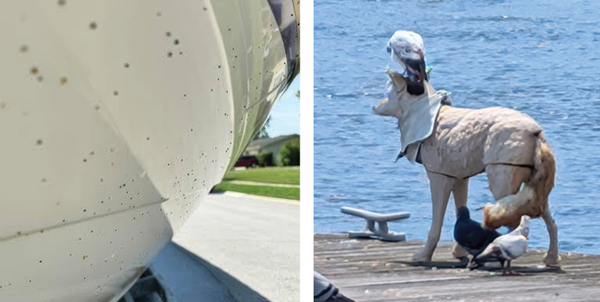
You may not even see a spider, but their presence shows up as tiny, black, tar-like
drops that stick tenaciously to vinyl boat seats and fiberglass and resist normal cleaning methods. These dots or splotches are spider droppings, which are acidic enough to damage the boat surfaces they stick to. So how do you clean them, and better yet, how can you prevent them?
Where is All the Spider Poop Coming From?
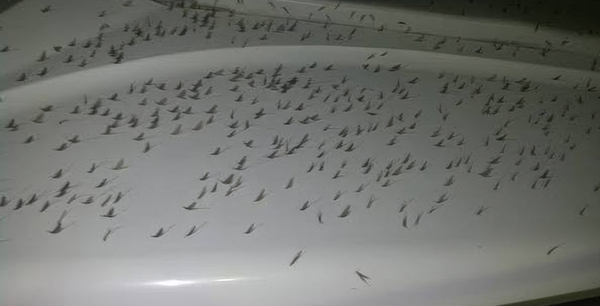
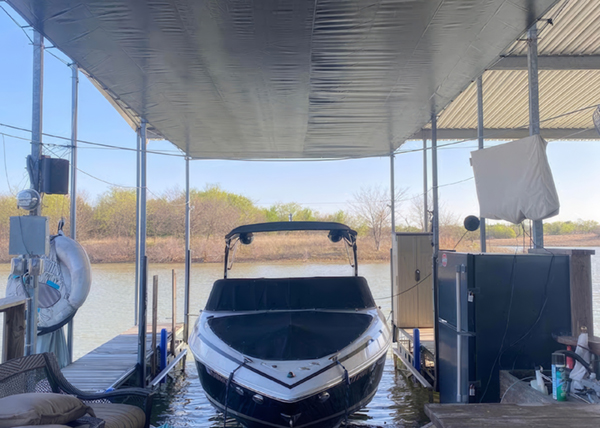
The first step in preventing the “rain” of terror is figuring out where the spiders are. Even if you’ve cleaned your boat carefully the week before, a startling number of new droppings can accumulate in a short period of time. Ironically, the worst source of spider droppings comes from above in covered boat slips. These roof eaves provide excellent habitat for spiders hunting insect prey, and the situation is worse in well-lit covered dockage because more insects are attracted to the light. Spraying poisons that can sink into the water harms the environment and may even be illegal, so use less harmful methods. First, regularly clean spider webs from the underside of the roof with a long-handled duster head that grabs them effectively. Good marinas often have someone do a web sweep every morning to keep the population low. But spiders are stubborn and resist leaving prime insect-hunting habitats. One clever solution is the Spider Diaper, a net that hangs over your boat and catches droppings before they splat on the deck or seats. Also, covering your boat after each use is a good practice.
Non-Toxic Sprays Are an Effective Weapon
For evicting spiders that crawl on a boat, there are a couple of solutions. Spiders are excellent at playing hide and seek and can find lots of nooks and crannies to take refuge in. For severe infestations, a bug bomb set under a boat cover is the most extreme option.
Fortunately, certain smells repel mice, roaches, and spiders, and peppermint oil tops the list, the active ingredient in Star Brite’s Spider Away. Boaters can also make their own spray using peppermint oil concentrate, which is sold as an essential oil. Combine 30 drops of oil with two cups of water, add ½ cup white vinegar and 1 teaspoon Dawn soap in a spray bottle, and shake well before using. Spray hard surfaces around the boat every couple of weeks or after a washdown. You don’t need much since the smell permeates. If the boat is docked, spray docklines to block pathways to the boat. If your boat has a cover, spray the perimeter around the cover’s edge to create a barrier.
Clean Up On Aisle Three
The worst part of a spider invasion is the cleanup. Droppings that have been on upholstery for a while are especially difficult, and using a soft-bristled brush and non-detergent soap like you normally would won’t cut it. Use cleaners specially formulated to tackle the specific chemical makeup of spider poop. Products like Star Brite Bird & Spider Stain Remover and Captain John’s Boat Brite Bird & Spider Droppings Stain Remover are effective and won’t damage boat surfaces like gelcoat and vinyl upholstery. Avoid any cleaner with bleach, especially on upholstery, because it destroys stitching, removes UV protectants and can strip color where it’s used. For hard surfaces, start by soaking the area with a hose, then apply cleaner to affected spots on the gelcoat and let it sit for a couple of minutes before scrubbing with a soft-bristled brush (a stiff brush can be used on non-skid surfaces). For upholstery, spray the cleaner on spider or bird spots, let it sit for a few minutes, wipe with a rag or paper towel, then hose it down. For stubborn upholstery stains, saturate a paper towel with the cleaner, place it over the spots, then wipe and rinse. Melamine sponges like Magic Erasers work well on non-skid surfaces but can dull shiny surfaces and damage upholstery.
Keep Your Boat Critter-Free During Long Layups
How to Evict Rodents from Your Boat. The best defense against invasions when a boat sits idle is to shrink-wrap it or cover it with a tight-fitting tarp, but even this isn’t foolproof. Although mice and rats don’t hibernate, any place that’s dry and covered is a potential nesting place. And if they figure out the upholstery is stuffed with foam, which makes excellent bedding, the results can be catastrophic.
Peppermint spray is a good deterrent but doesn’t always work. But beware of using poisons that could kill onboard mice, since they can hide before they die and create an even worse problem with a smell that won’t go away. Poisoned mice can also kill predators like owls and mammals that feed on them if they get off the boat. A clever and humane way to catch them is to use a five-gallon bucket with a lid that tips down when a mouse steps on it. A ramp leads them to the top, and they are attracted to the lid when you bait it with a smear of peanut butter and birdseed. When they walk to the edge, gravity does the rest, and they drop down. The next morning, take them for a drive in the country and let them go.
How to Handle Wasp and Bee Colonies
Wasps and bees find boats and motors to be attractive places to build colonies, and the presence of nests is nature’s subtle reminder that you aren’t going boating often enough. Wasps and bees occupy a valuable niche in the ecological chain, so relocation is better than eradication. Instead of spraying them with poison, use a garden hose with a medium-high pressure setting and melt the nest with water. Because the wasps view this as an extreme weather event, rather than a human attack, they don’t swarm the sprayer. Always maintain a maximum distance as you spray the nest.
Keeping Birds off Your Boat and Dock
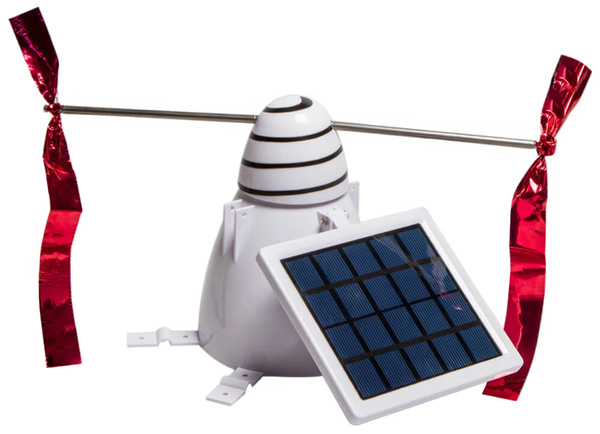
In many locations, birds roosting on your boat is a serious problem because they excrete copious guano while they lounge. Cleanups require a combination of warm water, specialized soap, a long-handled brush, and elbow grease. Keeping them off requires a multi-pronged attack. If you care about your neighbors, avoid electronic squawking devices, which annoy people more than birds. Statues of birds and coyotes might work temporarily, but birds are smart enough to notice when something hasn’t moved for a few weeks. The best devices have movement, like the Bird B Gone® Repeller 360 that uses the wind to spin a 6-foot pole with giant eyes on either end. Another dynamic device is the Spider 360 Daddy Long Legs that has a dozen flexible stainless steel wands that wave in the wind. For those times when the wind isn’t blowing, the Solar Bird Repeller spins a pair of reflective streamers around.
Keeping your boat clean and using it often are good first steps to keeping unwanted guests off your boat, but nature has a way of thwarting the best-laid plans. Taking a few proactive steps greatly reduces the chance of a critter invasion.
Back to Blue Life
The Problem With Spiders on a Boat
Spiders are one of the most successful animal orders on the planet and outnumber humans 4 million to one. About 53,000 species are spread across every continent except Antarctica, and they play an incredibly important role in our ecosystem, eating nearly a billion tons of insects a year. Unfortunately, they love boats as much as their owners, and while they creep out many people, what they leave behind is the real problem.
You may not even see a spider, but their presence shows up as tiny, black, tar-like
drops that stick tenaciously to vinyl boat seats and fiberglass and resist normal cleaning methods. These dots or splotches are spider droppings, which are acidic enough to damage the boat surfaces they stick to. So how do you clean them, and better yet, how can you prevent them?
Where is All the Spider Poop Coming From?
The first step in preventing the “rain” of terror is figuring out where the spiders are. Even if you’ve cleaned your boat carefully the week before, a startling number of new droppings can accumulate in a short period of time. Ironically, the worst source of spider droppings comes from above in covered boat slips. These roof eaves provide excellent habitat for spiders hunting insect prey, and the situation is worse in well-lit covered dockage because more insects are attracted to the light. Spraying poisons that can sink into the water harms the environment and may even be illegal, so use less harmful methods. First, regularly clean spider webs from the underside of the roof with a long-handled duster head that grabs them effectively. Good marinas often have someone do a web sweep every morning to keep the population low. But spiders are stubborn and resist leaving prime insect-hunting habitats. One clever solution is the Spider Diaper, a net that hangs over your boat and catches droppings before they splat on the deck or seats. Also, covering your boat after each use is a good practice.
Non-Toxic Sprays Are an Effective Weapon
For evicting spiders that crawl on a boat, there are a couple of solutions. Spiders are excellent at playing hide and seek and can find lots of nooks and crannies to take refuge in. For severe infestations, a bug bomb set under a boat cover is the most extreme option.
Fortunately, certain smells repel mice, roaches, and spiders, and peppermint oil tops the list, the active ingredient in Star Brite’s Spider Away. Boaters can also make their own spray using peppermint oil concentrate, which is sold as an essential oil. Combine 30 drops of oil with two cups of water, add ½ cup white vinegar and 1 teaspoon Dawn soap in a spray bottle, and shake well before using. Spray hard surfaces around the boat every couple of weeks or after a washdown. You don’t need much since the smell permeates. If the boat is docked, spray docklines to block pathways to the boat. If your boat has a cover, spray the perimeter around the cover’s edge to create a barrier.
Clean Up On Aisle Three
The worst part of a spider invasion is the cleanup. Droppings that have been on upholstery for a while are especially difficult, and using a soft-bristled brush and non-detergent soap like you normally would won’t cut it. Use cleaners specially formulated to tackle the specific chemical makeup of spider poop. Products like Star Brite Bird & Spider Stain Remover and Captain John’s Boat Brite Bird & Spider Droppings Stain Remover are effective and won’t damage boat surfaces like gelcoat and vinyl upholstery. Avoid any cleaner with bleach, especially on upholstery, because it destroys stitching, removes UV protectants and can strip color where it’s used. For hard surfaces, start by soaking the area with a hose, then apply cleaner to affected spots on the gelcoat and let it sit for a couple of minutes before scrubbing with a soft-bristled brush (a stiff brush can be used on non-skid surfaces). For upholstery, spray the cleaner on spider or bird spots, let it sit for a few minutes, wipe with a rag or paper towel, then hose it down. For stubborn upholstery stains, saturate a paper towel with the cleaner, place it over the spots, then wipe and rinse. Melamine sponges like Magic Erasers work well on non-skid surfaces but can dull shiny surfaces and damage upholstery.
Keep Your Boat Critter-Free During Long Layups
How to Evict Rodents from Your Boat. The best defense against invasions when a boat sits idle is to shrink-wrap it or cover it with a tight-fitting tarp, but even this isn’t foolproof. Although mice and rats don’t hibernate, any place that’s dry and covered is a potential nesting place. And if they figure out the upholstery is stuffed with foam, which makes excellent bedding, the results can be catastrophic.
Peppermint spray is a good deterrent but doesn’t always work. But beware of using poisons that could kill onboard mice, since they can hide before they die and create an even worse problem with a smell that won’t go away. Poisoned mice can also kill predators like owls and mammals that feed on them if they get off the boat. A clever and humane way to catch them is to use a five-gallon bucket with a lid that tips down when a mouse steps on it. A ramp leads them to the top, and they are attracted to the lid when you bait it with a smear of peanut butter and birdseed. When they walk to the edge, gravity does the rest, and they drop down. The next morning, take them for a drive in the country and let them go.
How to Handle Wasp and Bee Colonies
Wasps and bees find boats and motors to be attractive places to build colonies, and the presence of nests is nature’s subtle reminder that you aren’t going boating often enough. Wasps and bees occupy a valuable niche in the ecological chain, so relocation is better than eradication. Instead of spraying them with poison, use a garden hose with a medium-high pressure setting and melt the nest with water. Because the wasps view this as an extreme weather event, rather than a human attack, they don’t swarm the sprayer. Always maintain a maximum distance as you spray the nest.
Keeping Birds off Your Boat and Dock
In many locations, birds roosting on your boat is a serious problem because they excrete copious guano while they lounge. Cleanups require a combination of warm water, specialized soap, a long-handled brush, and elbow grease. Keeping them off requires a multi-pronged attack. If you care about your neighbors, avoid electronic squawking devices, which annoy people more than birds. Statues of birds and coyotes might work temporarily, but birds are smart enough to notice when something hasn’t moved for a few weeks. The best devices have movement, like the Bird B Gone® Repeller 360 that uses the wind to spin a 6-foot pole with giant eyes on either end. Another dynamic device is the Spider 360 Daddy Long Legs that has a dozen flexible stainless steel wands that wave in the wind. For those times when the wind isn’t blowing, the Solar Bird Repeller spins a pair of reflective streamers around.
Keeping your boat clean and using it often are good first steps to keeping unwanted guests off your boat, but nature has a way of thwarting the best-laid plans. Taking a few proactive steps greatly reduces the chance of a critter invasion.
Back to Blue Life