
What is your name and hometown?
My name is Greg Cudnick, I’m forty years old, and my hometown is Ship Bottom, New Jersey. It’s one of several shore towns on Long Beach Island. LBI is a barrier island that’s about 18 miles long and about a half mile wide at its widest point. It’s best known for two things: a beach vacation destination and fishing.
I was born and raised here and grew up fishing pretty much from the time I could walk. My dad, Stan, owns Fisherman’s Headquarters, considered one of the state’s premier tackle and bait stops. It’s located a couple blocks from the Route 72 bridge that crosses from the mainland onto the island.
Are you a charter captain or a private boat angler?
Well, growing up on an island, I guess I started off as a surf and bank fisherman, then a private boat angler and for the last 10 years I have been a light tackle guide fishing Barnegat Bay and ocean waters for fluke, striped bass, bluefish and weakfish. The rest of my time is devoted to being general manager of Fisherman’s Headquarters and to my family.
What is your current boat?
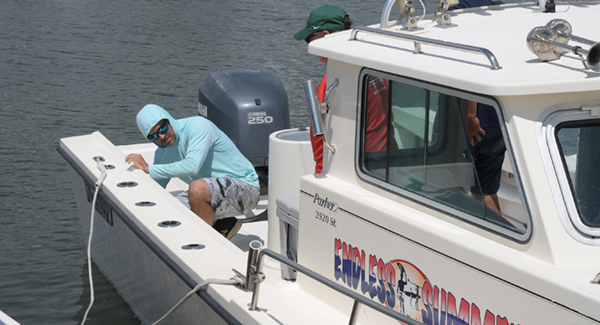
I run a Parker 2520 Sport Cabin, the Endless Summer, powered by a vintage Yamaha 250 HP outboard that has a lot of family history behind it. The boat was my uncle’s and when he passed away six years ago, my aunt asked me to clean it up and sell it for her. It had sat untouched for a couple years, but I fell in love with it. I was running a 21-foot center console at the time, but it didn’t have any place to get out of the sun or rain, and for early and late season fishing a cabin can’t be beat. My regulars love it, too. I did a lot of work to clean it up, installed new electronics, and a Rhodan trolling motor. After having the engine checked out by the local Yamaha dealer’s service tech, I decided to keep it rather than repower. It’s a 2005 model and only had 400 hours on it. Today the engine has clocked over 2,000 hours and it has been totally reliable. I do most of the basic maintenance myself, like Yamaha states, “Maintenance Matters.” Once a year I have it checked over by the dealer. Eventually, the time will come to repower and I’ll definitely be buying a new Yamaha.
Have you owned other boats in the past?
Before the Sport Cabin I had a Parker 21SE, a center console, with a Yamaha F150 that I bought from Hance and Smythe in Manahawkin, the same dealer where my uncle purchased the 2520. I’ve got nothing but good things to say about that boat and the F150. I never had a problem with the engine, which was a relief after having nothing but issues with other brands of outboards that I had on the boats I owned prior to the 21.
How long have you been fishing for fluke?
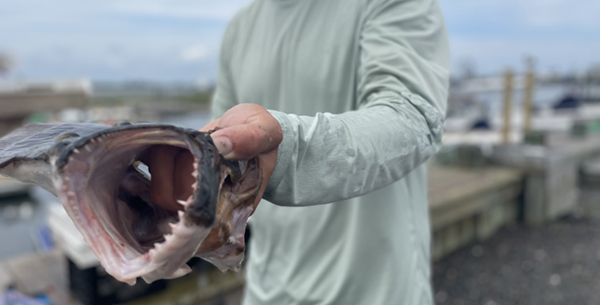
Growing up on an island surrounded by water and living over my parents’ tackle shop I probably started fishing for fluke not long after I learned to walk. The waters around LBI are fluke central with great early season fishing as soon as the season opens in early May. They enter the bay through Barnegat Inlet which is a stone’s throw away from where I keep my charter boat and pour into the bay to feed on the abundant grass shrimp, small crabs and baitfish. During the summer months there will still be fluke in the bay, but the best fishing is found on the ocean side of the island.
What do you consider your home waters for fluke?
When it comes to fluke, the center of my home waters is where I keep my boat in Barnegat Light, the town located at the northern tip of LBI. My fishing encompasses all of central Barnegat Bay which includes an extensive network of channels which are like the arteries that run through the bay, the sedge islands, bars and grassy bottom areas. Barnegat Inlet, just a stone’s throw from my slip, funnels ocean waters into the bay and bay waters back into the ocean with the changing tides. It is the heart that pumps life into the whole ecosystem. I fish the bay well to the north and south of the inlet area, especially in the spring when the fluke migrate into the warmer bay waters from the ocean to feed on the abundant forage. During the summer months my attention shifts to fishing ocean waters to the north and south of the inlet. I will fish spots all the way to mid-island in the south to some of the artificial reefs well north of the inlet. In the ocean I mostly fish around structure in 40 to 70-feet of water.
What is your favorite way to fish for fluke?
Spring fishing for fluke in Barnegat Bay is done with very light spinning tackle, light jig heads dressed with a variety of plastic shrimp imitations. Berkley makes several good ones in the Gulp line that work well simply because the fish are feeding so heavily on grass shrimp. I also fish with minnows, killies, on the same light tackle. I really enjoy fishing that way and so do my clients. I’ll drift grass beds and channel edges and use the trolling motor to maintain position and keep the drift at a manageable speed.
I take a different approach when fishing for fluke in the ocean, one that usually produces larger fluke. I work around specific types of structure and use the trolling motor to hold a position rather than drift. I have numbers for a bunch of old wrecks, ones that are more scattered rubble than being discernable as boats on the bottom, I’ll pick a spot I like, usually notches and open areas through the rubble, then put the trolling motor in Anchor Mode and fish straight up and down with a simple rig of my own design. I put a bank sinker on the bottom attached using a surgeon’s loop, a dropper a couple feet above it with a large 4/0 baitholder hook, and another loop at the top to connect it to the main line from the rod. I don’t use any hardware, snaps or swivels. The rig is attached to the running line of the reel using a loop-to-loop connection so I can change rigs quickly. I fish large strip baits of mackerel, fluke belly or other fish or large Gulp curly tails. I prefer sinkers over bucktails because they don’t get hung up in the rubble as easily as big bucktails. I’ll drop the sinker to the bottom and work the bait gently with the rod tip, so it flutters in the current. If I don’t get bites on one spot on the wreck, the trolling motor makes it easy to move around and reposition until I find a spot where fluke are holding. When I get bites, I’ll work that spot hard because fluke will frequently be found in groups. That technique has accounted for most of my biggest fluke and my charter customers find it to be an easy and effective technique to learn and master.
How big was the largest fluke you’ve caught to date?
Keep in mind that I don’t get to fish much myself because I am guiding clients to fish. I believe my personal biggest is somewhere over eight pounds. That said, I have had clients catch many over 10 pounds with the largest over twelve on charters. I also fish tournaments with a crew of other captains and mates. We won the Fluke-A-Mania tournament with a twelve pounder last year.
Do you have any tips for finding and catching fluke you can pass along to other anglers?
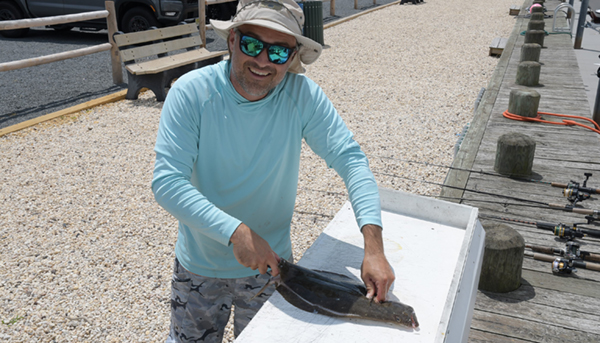
For fluke, I think the most important thing is to learn the area where you’ll be fishing. I know it sounds pretty basic but buy a good chart and study it. Download the latest Navionics chart for your chart plotter and use it to locate potential spots to concentrate your efforts. Many of the places I fish, including wrecks, artificial reefs and natural rock bottom, are marked on these charts and the bathymetric lines and depth contours are clearly presented. As you identify good spots to fish, you have to determine how the tides and currents are going to affect them and your approach to fishing them. That applies to fishing in the bay or ocean. The wind is also a factor because it can dictate where you can or cannot fish on any given day. For me, understanding how those factors will impact my day will determine where I am going to fish well before I leave the dock.
You should always have a main plan and alternates before you head out. If Plan A doesn’t pan out, have a Plan B and Plan C. For example, when I am fishing in bay waters in the spring there are channels running in every direction and not all of them are fishable under every wind and tide direction. If there is a south wind I know I can run to several places where the wind will either be blocked or where the wind will provide the right drift for that particular channel. If the wind shifts, I can go another. That’s what I mean about learning the areas you have available to fish. When you learn how tides and wind effect different spots you can plan your day to be at certain spots at specific times during the various tide phases that day. I even go so far as to set alarms on my smartphone to give me a heads-up on tide changes so if we’re not catching where we are, the alarm reminds me it’s time to move to my Plan B spots. I find understanding and learning how these environmental factors play into a game plan is far more important to fishing success than the rods and reels, line and rigs and even the baits you are using.
.jpg "Yamaha-Fishin-SaltVol18No4SummerFlounderimage5-(1).jpg")
What is your most memorable day of fishing for fluke?
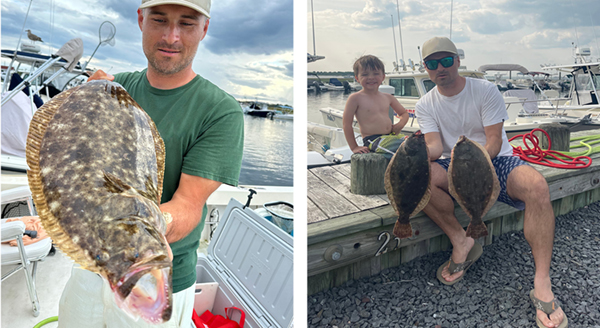
That would be the day my son Zach caught his first fluke. It was actually the first time I took him fishing on the boat and his mother came along. He was three at the time. Our tackle shop, Fisherman’s Headquarters in Ship Bottom, supports the local high school’s fishing club by donating tackle and awards and before that day we were at a club event and one of the vendors was selling these cute little Mickey Mouse fishing rod and reel outfits for five bucks. We bought one for Zach, I filled the reel up with some line, put a rubber casting sinker on it and he started playing with it in the house. He figured out how the button on the reel worked and how to pitch the sinker with the little rod, so we decided we’d put a kids PFD on him and take him out fishing
with us.
On the first spot, I put a live minnow on a tiny jig head, he dropped it in the water while sitting on a cooler so he could reach over the gunwale and sure enough, the rod starts bending almost immediately. I thought he was hung on the bottom, but he gave the rod a yank or two and holy moly, he was hooked up with a good fluke. The drag was giving line, he was turning the handle as fast as he could. I grabbed the net and put a three-pounder on the deck. We were all yelling and laughing and Zach was so proud of himself, and we were proud of him. That is an unforgettable memory that I will hold on to as he grows up.
We’d like to thank Greg for his insights into central Jersey summer flounder fishing. He has helped thousands of anglers from novice to experienced through his work at Fisherman’s Headquarters and as charter customers.
Back to Blue Life