

What is your name, hometown?
My name is Jim Freda, and I live in Pt. Pleasant, New Jersey. I was born in the northern part of the state but moved to Point in 1980. I guess living here for the past 46 years qualifies me as a Jersey shore native.
Are you a charter captain or a private boat angler?
I am a charter captain. My business is Shore Catch Sportfishing based out of Point Beach Yacht Club on a branch of the Manasquan River about a half mile from Manasquan Inlet and the open ocean. I am a graduate of Rutgers University with a teaching degree, and I taught science at Manasquan High until I retired recently. When school was in session, I chartered on weekends and pretty much every day during summer recess, but now I charter all year, except for the winter months.
What is your current boat?
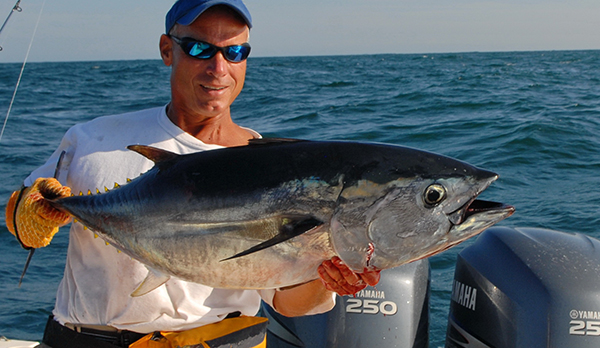
It is a 28’ Parker RXL sport cabin with twin 2024 Yamaha F250 outboards. I love the boat for a number of reasons, but especially for the cabin which gives me a place to get out of the weather and stay warm during early spring and late fall striped bass fishing. I like being dry and warm when going out and coming back at the end of a charter and my customers appreciate it, too. The boat is a 2005 that I purchased from the initial owner in 2010. The original Yamaha 250s had over 4,000 hours on them when I repowered two seasons ago and the new ones are great. They put out plenty of power, get the boat on plane fast, and cruise efficiently. On a typical charter the boat weighs in at about 10,000 pounds. That’s fully loaded with fuel, ice and several anglers and mate. Even at the weight, the engines get 1.2 MPG at cruise which I am happy with. The boat holds 250 gallons of fuel so I can run offshore, fish all day and come back with a comfortable reserve.
Have you owned other boats in the past?
My first boat after moving to the shore area was also a Parker, a 21’ Sport Cabin powered by a 150 horsepower Yamaha that I bought 35 years ago. It was my introduction to Yamaha outboards, and the combination of boat and motor was perfect. It was a great little boat. I got my captain’s license and chartered it for inshore and back bay trips. It was very affordable to run, but once I started getting into the remarkable bluefin tuna fishing we have off the Jersey coast it just wasn’t big enough to get me to the more distant fishing grounds, so I moved up to the 28 Sport Cabin.
How long have you been fishing for bluefin tuna?
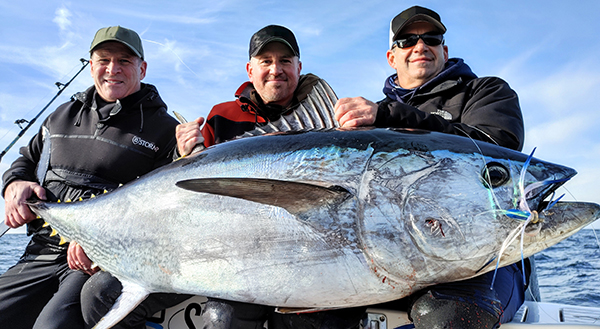
When I first started running charters, I fished strictly inshore and back bay waters targeting striped bass, bluefish, bonito and false albacore relatively close to the beach. But once I started to learn about bluefin and realized how readily available they were I started chasing them, initially with my old 21 Parker. That was 35 years ago and since then I’ve seen the seasonal patterns change over the years. Things like time they arrive in our waters, how close or far away from the beach they settle in, what forage species they are keying in on, those types of patterns. In my opinion the bluefin stocks are doing very, very well along the Eastern Seaboard and the most recent stock assessment confirms what we are seeing on the water. The population is very robust.
What do you consider your home waters for bluefin?
Thirty years ago, we would have schools of smaller bluefins we call footballs, that typically arrived around the middle to the end of May in the Mudhole, a run of 20 to 30 miles. They were close enough for the smaller Parker. But over the years, as more of the larger bluefin showed, I needed to expand my home waters. That is where the bigger boat came into play. It gave me more range and the safety of a bigger boat to reach them on more distant structure, so my current home waters now range eighty miles in a semicircle from Manasquan Inlet, and my catches of larger tuna have increased dramatically.
The last few years, we’ve been spoiled because we’ve had tremendous runs of bluefins beginning in May and they were often relatively close to the beach, from four to fifteen miles out. The early May/June fishing has been slower but once they start to show the numbers of fish moving inshore have been amazing and the fishing has been incredible. Last year they started showing in numbers around the beginning of July when a massive influx of loligo squid moved onto inshore structures like Barnegat Ridge. The tuna came in with them and fed on them for months. We are seeing squid again this year and hope the bluefin will be close behind. Many years they will hang around well into the fall and some years we even had giants, fish over 73 inches, come close to the beach chasing menhaden and sand eels.
What is your favorite way to fish for bluefin?
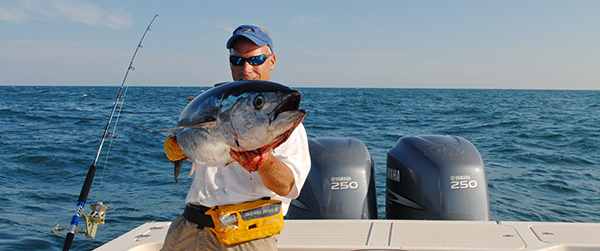
I have a few ways I prefer to fish for bluefin both personally and for my charter clients. They all revolve around having the rod in hand so you can feel the unmistakable strike, set the hook and hold on for that powerful first run. The techniques that provide that are jigging and casting plugs, poppers or stick baits. That said, when I go out, I tell my clients we are going to have everything on board to cover all the bases including trolling and bait for chunking. Even live bait if I can get it. The beauty of that is we can fish one way for an hour or two and switch over quickly when conditions warrant. We’re not locked into just one technique or another. But without a doubt, vertical jigging and casting plugs are our favorite ways to catch them.
What is the largest bluefin you or your clients have caught to date?
On a trip with two clients and Jimmy, a charter captain friend of mine, on December 4, 2011, there had been reports of large bluefin within four miles of the beach. I had just received an order of tuna stick baits from Japan, no one in the U.S. was making them at the time, and we had heavy spinning tackle to throw them. We were hunting around the Axel Carson Reef when we saw a group of bluefin feeding near the surface heading our way. Bob Morsiglia, one of the clients, made a long cast with a stick bait and hooked up with a huge fish. It was the biggest we’d ever encountered on spinning tackle and it tired out three of us passing the rod before it was gaffed a couple hours and seven miles from where it was hooked. It was seventy-three inches long and weight 240 pounds. I’ve hooked even bigger giants fishing live bunker but was unable to land them, even on much heavier tackle. They are just so strong and have incredible stamina.
Do you have any tips or insights for finding and catching bluefin you can pass along to other anglers?
Sure, there are plenty but one of the most important factors for success is assembling a good network of anglers that fish regularly to help you track the movements of these fish. That is even more important with the cost of fuel right now. You want to get detailed locations. With my network we exchange exact GPS positions for where we encounter tuna with each other because if you can go to where the fish were caught the day before it makes finding them that much easier. If the weather hasn’t changed and there’s still bait in the area chances are the tuna will be, too. If not, at least you’ve got a solid starting point to start determining where they have moved to.
If I don’t have any recent intel because no one had been out, maybe due to bad weather, I go back to my logs from prior years to see where I caught them and make that my starting point. Whenever I am heading to a starting point, I have everyone on board scanning the water all round the boat for any signs of life that can include whales, dolphin, tuna chicks, shearwaters, surface slicks or commotion. I call it all eyes on deck. My mate will be using binoculars to scan further off, and I am watching my radar for telltale signs of birds working far away and also watching the depthfinder for baitfish or tuna marks while we are cruising.
Tuna fishing is not a poor man’s game. It requires specialized tackle and you have to keep it in top condition. There’s no sense going through all the motions only to find your tackle isn’t up to challenging these very powerful fish. Always be prepared for immediate action. Have all the rods set up with various jigs, plugs and hook rigs for bait. Have the trolling outfits ready with spreader bars and ballyhoo rigged under Joe Shutes skirted heads so you can put out the trolling gear quickly. It all adds up to instant response when you come across the conditions indicating there are tuna in
the area.
.jpg "Yamaha-Fishin-SaltVol18No3Bluefinimage5-(1).jpg")
What is your most memorable bluefin tuna trip?
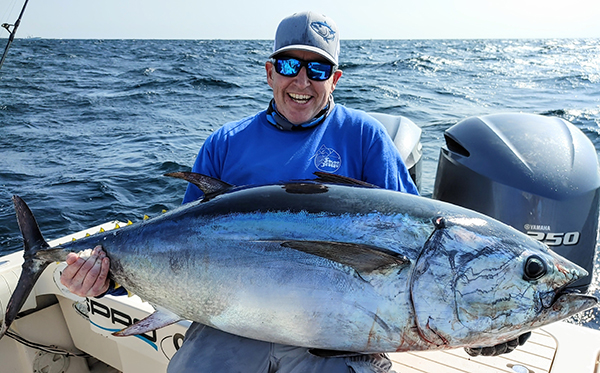
That would be the day my son, Tommy, caught his first tuna. Tommy is a captain in his own right today running a large Viking sportfishing yacht for a private owner, but he was about eight years old at the time. He started coming out with me at a younger age and I broke him in catching false albacore, a small member of the tuna clan, on light tackle. By the time he was eight I felt it was safe enough to take him on a bluefin trip and his first time out he hooked up on a jig and fought a 48-inch bluefin. He was so small I had to help him hold it up to take a picture of him with the fish. That is a very special memory. Back to Blue Life
My name is Jim Freda, and I live in Pt. Pleasant, New Jersey. I was born in the northern part of the state but moved to Point in 1980. I guess living here for the past 46 years qualifies me as a Jersey shore native.
Are you a charter captain or a private boat angler?
I am a charter captain. My business is Shore Catch Sportfishing based out of Point Beach Yacht Club on a branch of the Manasquan River about a half mile from Manasquan Inlet and the open ocean. I am a graduate of Rutgers University with a teaching degree, and I taught science at Manasquan High until I retired recently. When school was in session, I chartered on weekends and pretty much every day during summer recess, but now I charter all year, except for the winter months.
What is your current boat?
It is a 28’ Parker RXL sport cabin with twin 2024 Yamaha F250 outboards. I love the boat for a number of reasons, but especially for the cabin which gives me a place to get out of the weather and stay warm during early spring and late fall striped bass fishing. I like being dry and warm when going out and coming back at the end of a charter and my customers appreciate it, too. The boat is a 2005 that I purchased from the initial owner in 2010. The original Yamaha 250s had over 4,000 hours on them when I repowered two seasons ago and the new ones are great. They put out plenty of power, get the boat on plane fast, and cruise efficiently. On a typical charter the boat weighs in at about 10,000 pounds. That’s fully loaded with fuel, ice and several anglers and mate. Even at the weight, the engines get 1.2 MPG at cruise which I am happy with. The boat holds 250 gallons of fuel so I can run offshore, fish all day and come back with a comfortable reserve.
Have you owned other boats in the past?
My first boat after moving to the shore area was also a Parker, a 21’ Sport Cabin powered by a 150 horsepower Yamaha that I bought 35 years ago. It was my introduction to Yamaha outboards, and the combination of boat and motor was perfect. It was a great little boat. I got my captain’s license and chartered it for inshore and back bay trips. It was very affordable to run, but once I started getting into the remarkable bluefin tuna fishing we have off the Jersey coast it just wasn’t big enough to get me to the more distant fishing grounds, so I moved up to the 28 Sport Cabin.
How long have you been fishing for bluefin tuna?
When I first started running charters, I fished strictly inshore and back bay waters targeting striped bass, bluefish, bonito and false albacore relatively close to the beach. But once I started to learn about bluefin and realized how readily available they were I started chasing them, initially with my old 21 Parker. That was 35 years ago and since then I’ve seen the seasonal patterns change over the years. Things like time they arrive in our waters, how close or far away from the beach they settle in, what forage species they are keying in on, those types of patterns. In my opinion the bluefin stocks are doing very, very well along the Eastern Seaboard and the most recent stock assessment confirms what we are seeing on the water. The population is very robust.
What do you consider your home waters for bluefin?
Thirty years ago, we would have schools of smaller bluefins we call footballs, that typically arrived around the middle to the end of May in the Mudhole, a run of 20 to 30 miles. They were close enough for the smaller Parker. But over the years, as more of the larger bluefin showed, I needed to expand my home waters. That is where the bigger boat came into play. It gave me more range and the safety of a bigger boat to reach them on more distant structure, so my current home waters now range eighty miles in a semicircle from Manasquan Inlet, and my catches of larger tuna have increased dramatically.
The last few years, we’ve been spoiled because we’ve had tremendous runs of bluefins beginning in May and they were often relatively close to the beach, from four to fifteen miles out. The early May/June fishing has been slower but once they start to show the numbers of fish moving inshore have been amazing and the fishing has been incredible. Last year they started showing in numbers around the beginning of July when a massive influx of loligo squid moved onto inshore structures like Barnegat Ridge. The tuna came in with them and fed on them for months. We are seeing squid again this year and hope the bluefin will be close behind. Many years they will hang around well into the fall and some years we even had giants, fish over 73 inches, come close to the beach chasing menhaden and sand eels.
What is your favorite way to fish for bluefin?
I have a few ways I prefer to fish for bluefin both personally and for my charter clients. They all revolve around having the rod in hand so you can feel the unmistakable strike, set the hook and hold on for that powerful first run. The techniques that provide that are jigging and casting plugs, poppers or stick baits. That said, when I go out, I tell my clients we are going to have everything on board to cover all the bases including trolling and bait for chunking. Even live bait if I can get it. The beauty of that is we can fish one way for an hour or two and switch over quickly when conditions warrant. We’re not locked into just one technique or another. But without a doubt, vertical jigging and casting plugs are our favorite ways to catch them.
What is the largest bluefin you or your clients have caught to date?
On a trip with two clients and Jimmy, a charter captain friend of mine, on December 4, 2011, there had been reports of large bluefin within four miles of the beach. I had just received an order of tuna stick baits from Japan, no one in the U.S. was making them at the time, and we had heavy spinning tackle to throw them. We were hunting around the Axel Carson Reef when we saw a group of bluefin feeding near the surface heading our way. Bob Morsiglia, one of the clients, made a long cast with a stick bait and hooked up with a huge fish. It was the biggest we’d ever encountered on spinning tackle and it tired out three of us passing the rod before it was gaffed a couple hours and seven miles from where it was hooked. It was seventy-three inches long and weight 240 pounds. I’ve hooked even bigger giants fishing live bunker but was unable to land them, even on much heavier tackle. They are just so strong and have incredible stamina.
Do you have any tips or insights for finding and catching bluefin you can pass along to other anglers?
Sure, there are plenty but one of the most important factors for success is assembling a good network of anglers that fish regularly to help you track the movements of these fish. That is even more important with the cost of fuel right now. You want to get detailed locations. With my network we exchange exact GPS positions for where we encounter tuna with each other because if you can go to where the fish were caught the day before it makes finding them that much easier. If the weather hasn’t changed and there’s still bait in the area chances are the tuna will be, too. If not, at least you’ve got a solid starting point to start determining where they have moved to.
If I don’t have any recent intel because no one had been out, maybe due to bad weather, I go back to my logs from prior years to see where I caught them and make that my starting point. Whenever I am heading to a starting point, I have everyone on board scanning the water all round the boat for any signs of life that can include whales, dolphin, tuna chicks, shearwaters, surface slicks or commotion. I call it all eyes on deck. My mate will be using binoculars to scan further off, and I am watching my radar for telltale signs of birds working far away and also watching the depthfinder for baitfish or tuna marks while we are cruising.
Tuna fishing is not a poor man’s game. It requires specialized tackle and you have to keep it in top condition. There’s no sense going through all the motions only to find your tackle isn’t up to challenging these very powerful fish. Always be prepared for immediate action. Have all the rods set up with various jigs, plugs and hook rigs for bait. Have the trolling outfits ready with spreader bars and ballyhoo rigged under Joe Shutes skirted heads so you can put out the trolling gear quickly. It all adds up to instant response when you come across the conditions indicating there are tuna in
the area.
What is your most memorable bluefin tuna trip?
That would be the day my son, Tommy, caught his first tuna. Tommy is a captain in his own right today running a large Viking sportfishing yacht for a private owner, but he was about eight years old at the time. He started coming out with me at a younger age and I broke him in catching false albacore, a small member of the tuna clan, on light tackle. By the time he was eight I felt it was safe enough to take him on a bluefin trip and his first time out he hooked up on a jig and fought a 48-inch bluefin. He was so small I had to help him hold it up to take a picture of him with the fish. That is a very special memory. Back to Blue Life