
What is your name, hometown and where are your home waters?
My name is Ed Zyak, and I live in Jensen Beach, Florida. My home waters stretch from Jupiter Inlet to Sebastion, Florida. I fish inshore, run the beaches, and even go offshore when the conditions are right. On any given day, I could be found in one direction or another chasing sea trout, snook, tarpon, jacks, cobia, even mahi and sailfish.
Are you a charter captain or private boat angler?
I have been a professional captain/guide for the past 27 years. The time has gone by quickly and I have had a heck of a lot of fun taking people fishing. I love my job.
What is your current boat and power and what do you like about your Yamaha outboard?
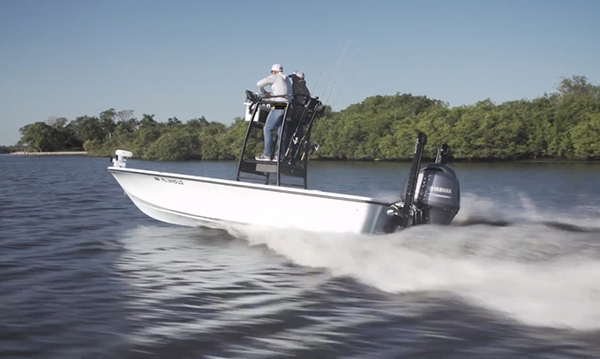
My current boat is a 22-foot Kenner bayboat powered by a Yamaha F200 four cylinder outboard. I bought the boat about 17 years ago but have made a lot of changes to it over the years. I totally revised the layout about four years ago in response to changes in the fisheries. When I first started fishing from the boat all those years ago it had a low console with a livewell in the console seat, which was fine. But as the fishing got harder it required a more technical approach, so I made a lot of changes to update it. I added a medium height tower with full controls which made it ideal for hunting fish and sight casting which has become an important part of my fishing. The improved sight lines the height provides is critical for any number of species I fish for depending on the time of the year. For example, this time of year I take clients sight-casting for tripletail that hang around navigational markers and crab pot floats and being higher off the water makes it easier to see fish long before they can see me. That improves our catch rate significantly.
When I first got the Kenner, it had an old Yamaha 200-hp OS66 outboard that just kept going and going and going. I thought it would never die and actually it never did, but when I rebuilt the boat, I changed a lot of things. I moved the batteries forward and switched around compartments and storage to lighten the boat in the stern. That allowed me to put a slightly heavier four-stroke outboard on the transom and the boat still floats level. Because of my experience with the old motor, I chose a new Yamaha F200 in-line four cylinder figuring it would be at least a reliable as the old Yamaha. It is much quieter, faster on plane, and the fuel savings are so dramatic it got me thinking I should have made the switch a long time ago! It burns half the fuel the old 200 burned with no oil mixing, no mess and it’s much easier to maintain. I couldn’t ask for a better engine to match the boat.
Have you owned other boats in the past?
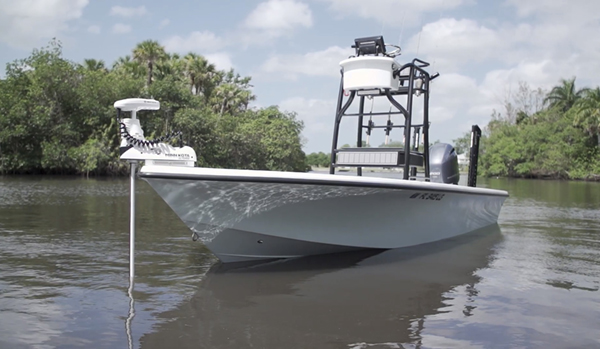
I have owned a ton of different boats, but they all seemed like a tradeoff. It was always like they would do one or two things well but then fall short on others. When I bought the Kenner, then made those critical modifications and upgraded to the F200 I finally had a boat that can do it all and do everything well. For river and flats fishing it floats dead level in very shallow water and is stealthy without hull slap when I am stalking fish. The hull has an ample V entry, so it eats up a chop when running in windy conditions like I find so often in places like the Indian River Lagoon. And it is right at home outside the inlets running the beaches while looking for cobia, tarpon, jack crevalle. I’ll take it far enough offshore to fish for mahi, blackfin tuna and even sailfish when the conditions are right.
How long have you been fishing for sea trout?
First, I have to say I love fishing for speckled trout. For years, I wanted to travel to all these legendary places for fish for them, the west coast of Florida, the Panhandle, the Chandeleur Islands, the Delta, and I did. But along the way I realized that the trout fishing in my home waters is as good or better than all those famous spots. Trout are truly one of my favorite species because I can take a group of kids out one day and put them on a bunch of fish or I can take out my most accomplished angler clients and challenge them to sight cast for trophy trout, the ones we call gator trout. Those are fish in the seven pound and up size and catching them in just inches of water is really an accomplishment.
What do you consider your home waters for sea trout?
The inside waters from Jupiter Inlet north to Sebastion are where I do most of my trout fishing with clients and the fishing here is as good as any place I have fished. It took a little time to learn such and extensive and intricate expanse of water, find where the best places to hunt them are but there is a great mix of big and small trout found throughout the Indian River complex. There is just so much great habitat.
What is your favorite way to fish for sea trout?
Without a doubt, my favorite way to fish for speckle trout is stalking and sight-casting to big ones, those gator trout I mentioned earlier. Sight fishing is very technical. It requires not just learning the skinny water areas where they can be found, but also the intricacies of approaching them without spooking them. Big trout in skinny water are among the most wary gamefish you will ever encounter.
What is your largest sea trout you’ve caught to date?
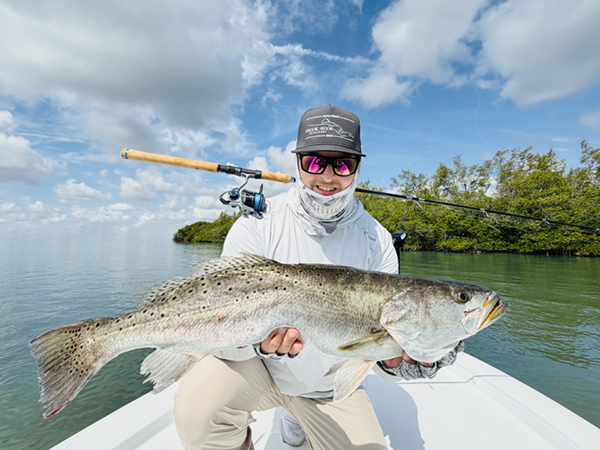
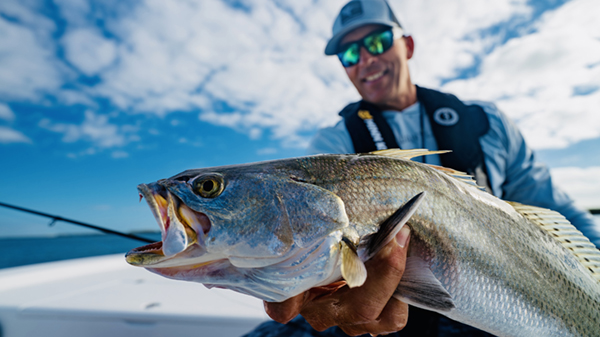
Well, there’s a story to that because not only is it my biggest, but it is also probably the most memorable trout I have even hooked. A bunch of guides were hosting a media event out of my hometown, Jensen Beach, and the weather was not great. The wind was blowing 25 knots and the place where I wanted to fish was a 12-mile run into the wind so not too many of the writers wanted to get aboard for the journey. Eventually, a writer from Florida Sportsman decided the long run in rough water was worth the possible reward, so he hopped aboard and away we went. The Kenner and Yamaha made the trip without a problem and when we got to the shallows the conditions looked good. On my sixth cast I hooked a monster, the biggest trout I had ever seen. After a great fight on light tackle, we boated a 14-pound speck, the fish of a lifetime and one I will never forget.
.jpg "Yamaha-Fishin-SaltVol18No2SeaTroutimage4-(1).jpg")
Do you have any tips for finding and catching trout you can pass along to other anglers?
Sure, especially when you’re targeting those gator trout. Those big fish have had predators trying to eat them since the day they hatched from eggs. Birds from above and fish from below. They are survivors, the most wary you will encounter. They are always aware of their surroundings and very skittish, easily startled and scared off. So, to target them successfully in shallow water you have to learn the importance of stealth and that requires focusing on the smallest of details.
The way I approach a flat where I think big trout might be present is calculated. I gauge the direction and strength of the wind and tide. Every rod is rigged and close at hand, no opening hatches or moving around the boat as I approach the flat. I will set up the approach with the wind and tide at my back so there’s no waves slapping on the side of the hull. The trolling motor will be dropped well away from the flat and I will only use it briefly to help control the natural drift that is carrying the boat into position. If I get to a position I want to hold, I will drop my Raptor anchor poles, but I try to stay well away, a long cast away from where the fish are feeding. I can see them from the tower, but I don’t want them to see me. The slightest noise or movement that rocks the boat will send vibrations into the water and the fish will know you’re there.
We use small spinning reels with light braid line and frequently use lures a little heavier than you might think so they can be cast a long distance. It’s important to present the bait without the fish ever knowing you are there because as soon as they sense you, they’re gone. Those are the most important things to consider when hunting big trout. It’s a battle of stealth against wariness.
What is your most memorable trip?
To this day, it was the run that put me on that 14-pound trout, my biggest one to date, that will remain forever imprinted in my memory.
Back to Blue Life
My name is Ed Zyak, and I live in Jensen Beach, Florida. My home waters stretch from Jupiter Inlet to Sebastion, Florida. I fish inshore, run the beaches, and even go offshore when the conditions are right. On any given day, I could be found in one direction or another chasing sea trout, snook, tarpon, jacks, cobia, even mahi and sailfish.
Are you a charter captain or private boat angler?
I have been a professional captain/guide for the past 27 years. The time has gone by quickly and I have had a heck of a lot of fun taking people fishing. I love my job.
What is your current boat and power and what do you like about your Yamaha outboard?
My current boat is a 22-foot Kenner bayboat powered by a Yamaha F200 four cylinder outboard. I bought the boat about 17 years ago but have made a lot of changes to it over the years. I totally revised the layout about four years ago in response to changes in the fisheries. When I first started fishing from the boat all those years ago it had a low console with a livewell in the console seat, which was fine. But as the fishing got harder it required a more technical approach, so I made a lot of changes to update it. I added a medium height tower with full controls which made it ideal for hunting fish and sight casting which has become an important part of my fishing. The improved sight lines the height provides is critical for any number of species I fish for depending on the time of the year. For example, this time of year I take clients sight-casting for tripletail that hang around navigational markers and crab pot floats and being higher off the water makes it easier to see fish long before they can see me. That improves our catch rate significantly.
When I first got the Kenner, it had an old Yamaha 200-hp OS66 outboard that just kept going and going and going. I thought it would never die and actually it never did, but when I rebuilt the boat, I changed a lot of things. I moved the batteries forward and switched around compartments and storage to lighten the boat in the stern. That allowed me to put a slightly heavier four-stroke outboard on the transom and the boat still floats level. Because of my experience with the old motor, I chose a new Yamaha F200 in-line four cylinder figuring it would be at least a reliable as the old Yamaha. It is much quieter, faster on plane, and the fuel savings are so dramatic it got me thinking I should have made the switch a long time ago! It burns half the fuel the old 200 burned with no oil mixing, no mess and it’s much easier to maintain. I couldn’t ask for a better engine to match the boat.
Have you owned other boats in the past?
I have owned a ton of different boats, but they all seemed like a tradeoff. It was always like they would do one or two things well but then fall short on others. When I bought the Kenner, then made those critical modifications and upgraded to the F200 I finally had a boat that can do it all and do everything well. For river and flats fishing it floats dead level in very shallow water and is stealthy without hull slap when I am stalking fish. The hull has an ample V entry, so it eats up a chop when running in windy conditions like I find so often in places like the Indian River Lagoon. And it is right at home outside the inlets running the beaches while looking for cobia, tarpon, jack crevalle. I’ll take it far enough offshore to fish for mahi, blackfin tuna and even sailfish when the conditions are right.
How long have you been fishing for sea trout?
First, I have to say I love fishing for speckled trout. For years, I wanted to travel to all these legendary places for fish for them, the west coast of Florida, the Panhandle, the Chandeleur Islands, the Delta, and I did. But along the way I realized that the trout fishing in my home waters is as good or better than all those famous spots. Trout are truly one of my favorite species because I can take a group of kids out one day and put them on a bunch of fish or I can take out my most accomplished angler clients and challenge them to sight cast for trophy trout, the ones we call gator trout. Those are fish in the seven pound and up size and catching them in just inches of water is really an accomplishment.
What do you consider your home waters for sea trout?
The inside waters from Jupiter Inlet north to Sebastion are where I do most of my trout fishing with clients and the fishing here is as good as any place I have fished. It took a little time to learn such and extensive and intricate expanse of water, find where the best places to hunt them are but there is a great mix of big and small trout found throughout the Indian River complex. There is just so much great habitat.
What is your favorite way to fish for sea trout?
Without a doubt, my favorite way to fish for speckle trout is stalking and sight-casting to big ones, those gator trout I mentioned earlier. Sight fishing is very technical. It requires not just learning the skinny water areas where they can be found, but also the intricacies of approaching them without spooking them. Big trout in skinny water are among the most wary gamefish you will ever encounter.
What is your largest sea trout you’ve caught to date?
Well, there’s a story to that because not only is it my biggest, but it is also probably the most memorable trout I have even hooked. A bunch of guides were hosting a media event out of my hometown, Jensen Beach, and the weather was not great. The wind was blowing 25 knots and the place where I wanted to fish was a 12-mile run into the wind so not too many of the writers wanted to get aboard for the journey. Eventually, a writer from Florida Sportsman decided the long run in rough water was worth the possible reward, so he hopped aboard and away we went. The Kenner and Yamaha made the trip without a problem and when we got to the shallows the conditions looked good. On my sixth cast I hooked a monster, the biggest trout I had ever seen. After a great fight on light tackle, we boated a 14-pound speck, the fish of a lifetime and one I will never forget.
Do you have any tips for finding and catching trout you can pass along to other anglers?
Sure, especially when you’re targeting those gator trout. Those big fish have had predators trying to eat them since the day they hatched from eggs. Birds from above and fish from below. They are survivors, the most wary you will encounter. They are always aware of their surroundings and very skittish, easily startled and scared off. So, to target them successfully in shallow water you have to learn the importance of stealth and that requires focusing on the smallest of details.
The way I approach a flat where I think big trout might be present is calculated. I gauge the direction and strength of the wind and tide. Every rod is rigged and close at hand, no opening hatches or moving around the boat as I approach the flat. I will set up the approach with the wind and tide at my back so there’s no waves slapping on the side of the hull. The trolling motor will be dropped well away from the flat and I will only use it briefly to help control the natural drift that is carrying the boat into position. If I get to a position I want to hold, I will drop my Raptor anchor poles, but I try to stay well away, a long cast away from where the fish are feeding. I can see them from the tower, but I don’t want them to see me. The slightest noise or movement that rocks the boat will send vibrations into the water and the fish will know you’re there.
We use small spinning reels with light braid line and frequently use lures a little heavier than you might think so they can be cast a long distance. It’s important to present the bait without the fish ever knowing you are there because as soon as they sense you, they’re gone. Those are the most important things to consider when hunting big trout. It’s a battle of stealth against wariness.
What is your most memorable trip?
To this day, it was the run that put me on that 14-pound trout, my biggest one to date, that will remain forever imprinted in my memory.
Back to Blue Life