
What is your name and hometown?
“Mike Holliday and I’ve lived in Stuart, Florida since 1978 except for a six-year stint living in New Jersey in my teens.”
Are you a charter captain or private boat angler?
“I earned my USCG Master Captains license in 1986 and have been fishing the waters of the Indian and St. Lucie Rivers and the Atlantic Ocean from Vero Beach to Jupiter specializing in fishing for snook, tarpon, cobia, sailfish, sea trout, bonito, kingfish, dolphin and permit on spin and fly tackle.”
What is your current boat and power and what do you like about your Yamaha outboard?
“I currently run a Pathfinder® 2300 HPS bayboat with a Yamaha V Max 250 SHO® outboard. It is outfitted with the latest GPS/sonar/side imaging technology from Humminbird®, a Minn Kota® Ultra trolling motor and twin Raptor® shallow water anchoring systems, everything needed to fish my home waters with speed and stealth.
“There are so many things about my Yamahas that I love, but the biggest single benefit for me is reliability. Every morning when I leave the dock, I know I am going to make it home. On top of that, the fuel economy is exceptional, and the quietness for a high-powered four-stroke is amazing! The midrange acceleration is excellent and because it is lighter than most outboards in its class I can get into shallower water. And it doesn’t make my boat squat in the stern at rest or coming on plane. I have had ten of them since they were introduced and all of them have been totally dependable.”
Have you owned other boats in the past?
“I have had twenty-seven boats to date, all built by the Maverick Boat Group. A 21’ Maverick®, 19’ Hewes®, 21’ Hewes®, 18’ Maverick®, 22’ Pathfinder®, 24’ Pathfinder®, just to name a few.”
How long have you been fishing for snook?
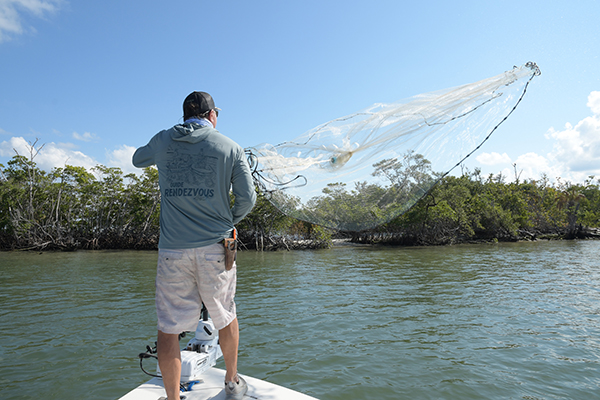
“I grew up in south Florida and snook have been one of my favorite target species since I was a kid. Long before I started taking clients fishing professionally, even before I owned my first boat, I was fascinated by fishing for snook, and they remain my favorite gamefish. It might have something to do with the fact that this area has some of the best snook fishing anywhere in the world, but the fish itself is unique and great fun to catch on
light tackle.
What do you consider your home waters for snook?
“For snook specifically, I will run from Jupiter to Sebastion Inlet but the majority of my snook fishing is closer to home in the Stuart-Fort Pierce area. That said, their range has changed over the last ten to twelve years with the warming climate and water temperatures. In the past, the northern range for snook in Florida was around Melbourne but now we are seeing them push all the way up to the Jacksonville area in the very northern part of the state. Snook are also found on the west coast of Florida, but rarely into the northern part of the Gulf side until now. I talk to fishermen in Alabama, and they are seeing snook in their waters where they never had before. That is way north of their normal range but if we get some cold weather, and we do every few years, there will be a die-off. For example, in 2010 we had several days of unusually cold weather with nighttime temperatures dropping into the 30s and there was a major snook kill as a result. The species is very temperature sensitive and if the water temperatures get into the fifties, snook will die.
“In my opinion, snook stocks are suffering locally, mostly from habitat loss due to the polluted runoff problems from the center of the state. When they open the locks to relieve water levels from Okeechobee, the rush of dirty freshwater kills the natural sea grasses. The loss of sea grass in the St. Lucie and Indian rivers has been devastating and caused a major shift in where we fish for snook. We have also seen a shift in the bigger fish on the east coast moving offshore onto the reefs. From satellite tagging studies we learned that they still move back into the inlets to spawn and feed for a while, but they don’t come back into the rivers and lagoons for any significant amount of time. As a result, I fish around structure like docks, points, mangroves, whereas I used to spend all my time fishing on the vast grass beds that now are almost completely gone.
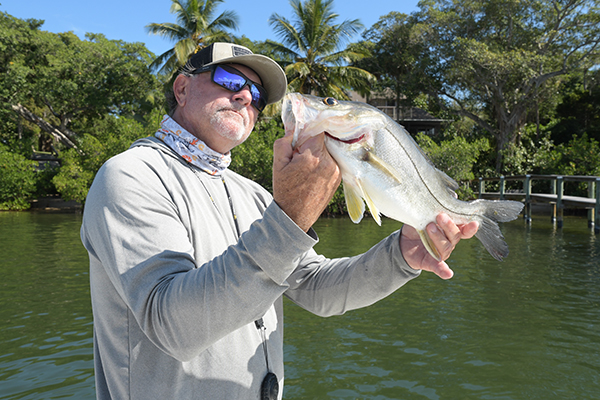
“Not everyone realizes that there are actually four subspecies of snook in Florida waters, the common snook, which is the largest can grow to forty pounds or more. The Cuban or fat snook has become increasingly more common, but rarely gets larger than twenty-eight inches, and the tarpon snook barely grows to sixteen inches. The smallest and rarest of the four is the swordspine snook, which is tiny, barely larger than twelve inches.”
What is your favorite way to fish for snook?
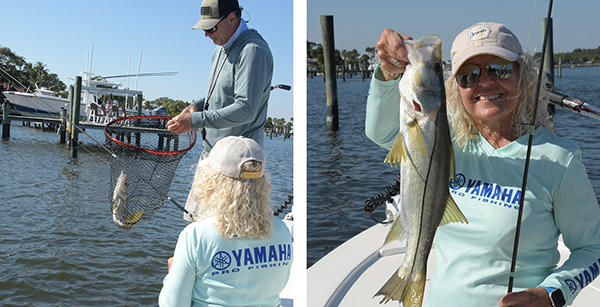
“There are so many ways to target them that it’s almost hard to pick one. Snook are extremely aggressive, so when you make a presentation to one hunkered down at an ambush point, they usually eat your offering. That said, topwater plugs are the most dramatic and exciting way to catch snook. They have huge mouths and when they attack a surface bait, they tend to blow it out of the water on the first try, then come back and smack it again so it’s like a double blow up. They are strong, fight hard and are quite fast when pulling drag. Live bait fishing is great fun because when a snook eats a bait it inhales it whole and there is a definitive bump before the line comes tight. Keep in mind that circle hooks are required when fishing live bait in Florida and that’s all I ever use.”
What is your largest snook to date?
“The biggest snook I have ever seen I hooked while fishing on foot off the Hobe Sound Bridge at night and weighed forty pounds. I hooked it on a live mullet from the top of the bridge, and a passing FWC Marine Patrol officer saw me fighting the fish and pulled over to watch. When he saw how big it was in the bridge lights he got as excited as I was. Since there was no way to land the fish from the bridge span, he ran down to the embankment below and when I worked the fish close enough, he grabbed it. He weighed it on his official scale, and it was an honest forty pounds, before we released it together and watched it swim away.”
Do you have any tips for finding and catching snook you can pass along to other anglers?
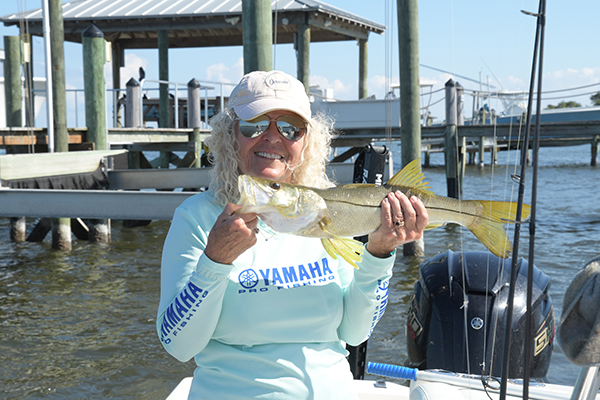
“Sure. Snook are a schooling fish that feed in and near moving water. They want the food to flow to them while they sit tight to structure and then charge out at passing shrimp, crabs, or baitfish. They will also sit in a pothole in a grass bed if you are in an area where the grass beds still exist. Points of land where the current curves around are also excellent ambush points. They typically don’t move too far from their ambush point although there are times that they will dog a lure or bait that passed them before striking it. If you find spots with good current chances are there will be more snook feeding there. Outgoing tides are usually better that incoming because shrimp and crabs are on the move and outgoing pulls more baits toward the inlets. Inlets are good spots to concentrate your efforts because the tides are predictable and move warm water in and out of the estuaries.
.jpg "Yamaha-Fishin-Salt-6SnookFishingHollidayimage4-(1).jpg")
What is your most memorable fishing trip?
“I have so many memorable snook trips but one that stands out and always makes me smile took place when I was fishing one of my regular customers, a gentleman well into his 80s. I was chumming snook to the surface so he could cast flies to them and he was hooking one on almost every cast. These were good size fish from twelve to fifteen pounds, one was well over twenty-five, so they fought hard on his seven-weight rod. But what made it so memorable was he was not an exceptional angler; he just loved being out on the water. So, every time he hooked another fish, and he hooked many that day, he would laugh like a little kid and he had me laughing right along with him. It brought so much joy to him, and it made me realize that times like that are why I do what I do. It’s not the money, there aren’t many wealthy fishing guides unless they were wealthy before they started guiding, it’s the way fishing brings so much joy to so many people. That man had such a wonderful time it made me feel good in a very special way.”
Yamaha would like to thank Mike for his insights taken from years of experience on the water. In addition to being a working guide, he is involved in conservation issues with Captains for Clean Water, Bonefish and Tarpon Trust, The International Game Fish Association, Coastal Conservation Association of Florida and Trout Unlimited. He is an accomplished outdoor writer and has worked for The Miami Herald and The Palm Beach Post, The Fort Pierce Tribune and The Stuart News. He was editor at Florida Sportsman Magazine and the editor of Florida Fishing Weekly. He has had features and photos published in all the major national and regional outdoor publications - including ESPN and The New York Times. He can be reached through his website at www.captmikeholliday.com. Y
Back to Blue Life
“Mike Holliday and I’ve lived in Stuart, Florida since 1978 except for a six-year stint living in New Jersey in my teens.”
Are you a charter captain or private boat angler?
“I earned my USCG Master Captains license in 1986 and have been fishing the waters of the Indian and St. Lucie Rivers and the Atlantic Ocean from Vero Beach to Jupiter specializing in fishing for snook, tarpon, cobia, sailfish, sea trout, bonito, kingfish, dolphin and permit on spin and fly tackle.”
What is your current boat and power and what do you like about your Yamaha outboard?
“I currently run a Pathfinder® 2300 HPS bayboat with a Yamaha V Max 250 SHO® outboard. It is outfitted with the latest GPS/sonar/side imaging technology from Humminbird®, a Minn Kota® Ultra trolling motor and twin Raptor® shallow water anchoring systems, everything needed to fish my home waters with speed and stealth.
“There are so many things about my Yamahas that I love, but the biggest single benefit for me is reliability. Every morning when I leave the dock, I know I am going to make it home. On top of that, the fuel economy is exceptional, and the quietness for a high-powered four-stroke is amazing! The midrange acceleration is excellent and because it is lighter than most outboards in its class I can get into shallower water. And it doesn’t make my boat squat in the stern at rest or coming on plane. I have had ten of them since they were introduced and all of them have been totally dependable.”
Have you owned other boats in the past?
“I have had twenty-seven boats to date, all built by the Maverick Boat Group. A 21’ Maverick®, 19’ Hewes®, 21’ Hewes®, 18’ Maverick®, 22’ Pathfinder®, 24’ Pathfinder®, just to name a few.”
How long have you been fishing for snook?
“I grew up in south Florida and snook have been one of my favorite target species since I was a kid. Long before I started taking clients fishing professionally, even before I owned my first boat, I was fascinated by fishing for snook, and they remain my favorite gamefish. It might have something to do with the fact that this area has some of the best snook fishing anywhere in the world, but the fish itself is unique and great fun to catch on
light tackle.
What do you consider your home waters for snook?
“For snook specifically, I will run from Jupiter to Sebastion Inlet but the majority of my snook fishing is closer to home in the Stuart-Fort Pierce area. That said, their range has changed over the last ten to twelve years with the warming climate and water temperatures. In the past, the northern range for snook in Florida was around Melbourne but now we are seeing them push all the way up to the Jacksonville area in the very northern part of the state. Snook are also found on the west coast of Florida, but rarely into the northern part of the Gulf side until now. I talk to fishermen in Alabama, and they are seeing snook in their waters where they never had before. That is way north of their normal range but if we get some cold weather, and we do every few years, there will be a die-off. For example, in 2010 we had several days of unusually cold weather with nighttime temperatures dropping into the 30s and there was a major snook kill as a result. The species is very temperature sensitive and if the water temperatures get into the fifties, snook will die.
“In my opinion, snook stocks are suffering locally, mostly from habitat loss due to the polluted runoff problems from the center of the state. When they open the locks to relieve water levels from Okeechobee, the rush of dirty freshwater kills the natural sea grasses. The loss of sea grass in the St. Lucie and Indian rivers has been devastating and caused a major shift in where we fish for snook. We have also seen a shift in the bigger fish on the east coast moving offshore onto the reefs. From satellite tagging studies we learned that they still move back into the inlets to spawn and feed for a while, but they don’t come back into the rivers and lagoons for any significant amount of time. As a result, I fish around structure like docks, points, mangroves, whereas I used to spend all my time fishing on the vast grass beds that now are almost completely gone.
“Not everyone realizes that there are actually four subspecies of snook in Florida waters, the common snook, which is the largest can grow to forty pounds or more. The Cuban or fat snook has become increasingly more common, but rarely gets larger than twenty-eight inches, and the tarpon snook barely grows to sixteen inches. The smallest and rarest of the four is the swordspine snook, which is tiny, barely larger than twelve inches.”
What is your favorite way to fish for snook?
“There are so many ways to target them that it’s almost hard to pick one. Snook are extremely aggressive, so when you make a presentation to one hunkered down at an ambush point, they usually eat your offering. That said, topwater plugs are the most dramatic and exciting way to catch snook. They have huge mouths and when they attack a surface bait, they tend to blow it out of the water on the first try, then come back and smack it again so it’s like a double blow up. They are strong, fight hard and are quite fast when pulling drag. Live bait fishing is great fun because when a snook eats a bait it inhales it whole and there is a definitive bump before the line comes tight. Keep in mind that circle hooks are required when fishing live bait in Florida and that’s all I ever use.”
What is your largest snook to date?
“The biggest snook I have ever seen I hooked while fishing on foot off the Hobe Sound Bridge at night and weighed forty pounds. I hooked it on a live mullet from the top of the bridge, and a passing FWC Marine Patrol officer saw me fighting the fish and pulled over to watch. When he saw how big it was in the bridge lights he got as excited as I was. Since there was no way to land the fish from the bridge span, he ran down to the embankment below and when I worked the fish close enough, he grabbed it. He weighed it on his official scale, and it was an honest forty pounds, before we released it together and watched it swim away.”
Do you have any tips for finding and catching snook you can pass along to other anglers?
“Sure. Snook are a schooling fish that feed in and near moving water. They want the food to flow to them while they sit tight to structure and then charge out at passing shrimp, crabs, or baitfish. They will also sit in a pothole in a grass bed if you are in an area where the grass beds still exist. Points of land where the current curves around are also excellent ambush points. They typically don’t move too far from their ambush point although there are times that they will dog a lure or bait that passed them before striking it. If you find spots with good current chances are there will be more snook feeding there. Outgoing tides are usually better that incoming because shrimp and crabs are on the move and outgoing pulls more baits toward the inlets. Inlets are good spots to concentrate your efforts because the tides are predictable and move warm water in and out of the estuaries.
What is your most memorable fishing trip?
“I have so many memorable snook trips but one that stands out and always makes me smile took place when I was fishing one of my regular customers, a gentleman well into his 80s. I was chumming snook to the surface so he could cast flies to them and he was hooking one on almost every cast. These were good size fish from twelve to fifteen pounds, one was well over twenty-five, so they fought hard on his seven-weight rod. But what made it so memorable was he was not an exceptional angler; he just loved being out on the water. So, every time he hooked another fish, and he hooked many that day, he would laugh like a little kid and he had me laughing right along with him. It brought so much joy to him, and it made me realize that times like that are why I do what I do. It’s not the money, there aren’t many wealthy fishing guides unless they were wealthy before they started guiding, it’s the way fishing brings so much joy to so many people. That man had such a wonderful time it made me feel good in a very special way.”
Yamaha would like to thank Mike for his insights taken from years of experience on the water. In addition to being a working guide, he is involved in conservation issues with Captains for Clean Water, Bonefish and Tarpon Trust, The International Game Fish Association, Coastal Conservation Association of Florida and Trout Unlimited. He is an accomplished outdoor writer and has worked for The Miami Herald and The Palm Beach Post, The Fort Pierce Tribune and The Stuart News. He was editor at Florida Sportsman Magazine and the editor of Florida Fishing Weekly. He has had features and photos published in all the major national and regional outdoor publications - including ESPN and The New York Times. He can be reached through his website at www.captmikeholliday.com. Y
Back to Blue Life