
What is your name and hometown?
Capt. Andy LoCascio
Are you a charter captain or private boat angler?
“I’ve been a professional fishing captain for over 30 years, and I have a partner in our charter company, Long Island Fishing Charters, Capt. Joby Vinarski. Our home base is Port Washington on the north shore of Long Island.”
What is your current boat and power and what do you like about your Yamaha outboard?
“My personal boat is a 34’ Regulator powered with triple Yamaha F300 outboards, but our charter service consists of a second Regulator, two Triton center consoles and a Gloucester G20 center console. All of the boats are Yamaha powered.
“I’ve owned a lot of boats and considered the Regulator to be the finest center console ever built. My 34 is a beast and the Yamaha outboards are dependable, quiet and fuel efficient and provide the power to cruise comfortably at 40 knots in almost any sea. The ride is incredibly smooth and dry. My family and friends love it and so do our charter clients.”
Have you owned other boats in the past?
“I’ve owned many boats over the years including a couple Edgewaters and Tritons both as personal boats and for our charter service. The two Regulators we currently own are our first experience with the brand, and I can’t say enough good things about them.”
How long have you been fishing for fluke?
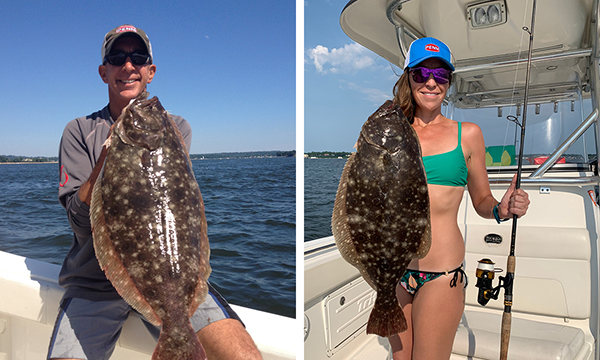
“I started fishing for fluke seriously soon after I graduated from college in my home waters in the western Long Island Sound. I started chartering quite a few years after that. I co-created and was featured in Northeast Angling TV, and during the years we were shooting shows I got to fish for fluke from New Jersey to Maine with the very best captains in each of those regions. A lot of people don’t realize that fluke range as far north as southern Maine and the fishing for giant fluke off Massachusetts and Rhode Island is legendary. The numbers of huge fluke they catch there attracts anglers from all over.”
What do you consider your home waters?
“I call the extensive waters of western Long Island Sound home. We typically start seeing an influx of fluke into the Sound around in early May and the amount of fish peaks by late June and into July and August, although it’s a little different every year. Some years we see very good numbers of fluke, but not a lot of the larger keeper size fish. Other years the mix of bigger fish makes putting together a limit easy. The New York size limit is currently 19-inches and that’s a good-sized fluke.
“When I target larger fluke, five pounds and up, we head offshore to hard bottom. The larger fluke gravitate to that kind of structure while the near-shore sandy areas will usually hold plenty of small fish but few keeper-size fish. Luckily the Sound has an amazing amount of hard bottom structure to explore, so much so that it can sometimes be a handicap because even with the expansion of the fluke stocks in recent years, they can’t be everywhere.”
Note: The size limit and open season for fluke varies from state to state. Each state sets regulations to best accommodate the anglers within their state adjusted for the annual quota apportioned to them by NOAA federal regulators. Last year, the New York season stretched from May 4 to October 15 with a minimum size of 19 inches in the early part of the season, increasing to 19.5 inches after August 2. The large minimum size allows the state to keep the season open longer but also makes finding keeper size fish more difficult.
What is your favorite way to fish for fluke?
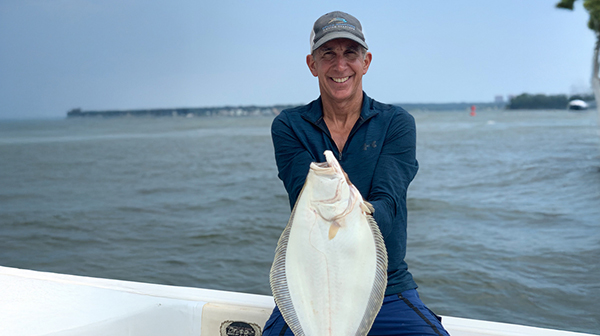
“My favorite way to fish for fluke is using bucktails. It’s a more active way to fish and you have the rod in your hand when you get a bite and have to set the hook. I’ll go to an area of hard bottom, judge the drift created by a combination of wind and current, and stem the tide. Bucktails are absolutely the most effective method for catching fluke and we fish them with Berkley Gulp soft tails, squid strips, spearing and even peanut bunker when we can get them. I try to stem the tide, which means the boat is drifting slow enough that we can work the bucktails straight up and down, keeping them dancing with movement imparted by the angler, rather than playing out a lot of line. This requires using heavy enough bucktails to match the drift speed.
“We also use double bucktail rigs with a heavier one of the bottom and a lighter one on a dropper a couple feet above to present two baits, but last year we didn’t use the high-low as much because we had so many scup (porgies) and sea robins hitting the high hook it made it harder to target the fluke. For that reason, we used single bucktails and kept them closer to the bottom. The best hard bottom areas are in the 25-to-55-foot range and when we mark bait close to the bottom that’s an area we want to fish.”
What is your biggest fluke to date?
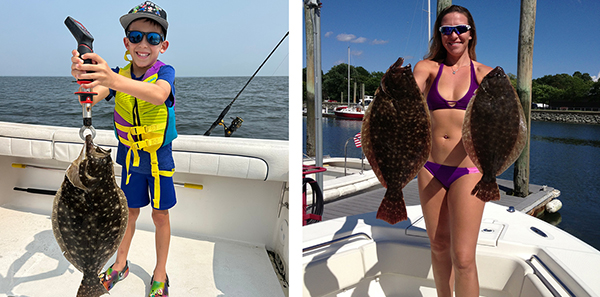
“The biggest fluke caught by one of my charter customers was over 14 pounds, a real trophy no matter where you fish. My personal best was a bit over 12 pounds, also considered to be a doormat. Doormat is a term that refers to fluke generally over 10 pounds.”
Do you have any tips for finding and catching summer fluke you can pass along to other anglers?
“Your best bet is to realize that as aggressive as fluke are they aren’t always feeding. You might be on great looking bottom with bait showing in the right depth zone but you’re not catching. That doesn’t mean they aren’t there, or it could mean you need to move. Learning how different stages of the tide can trigger feeding is all a part of becoming a better fluke fisherman. That takes time on the water, experimentation and experience. If you’re confident in a spot but not getting bites you might choose to wait until the tide changes. If you’re not that confident in the spot and feel the fish just aren’t there, then you might choose to make a move to a new one. This is something that is hard to teach and requires keeping a careful eye on tide stages and bait availability each trip. Sometimes just making a short move can make all the difference in catching fluke. There’s an area we fish in the far western end of the sound called Hart’s Island. It’s only about a mile long and sometimes the fish won’t be biting on one side of the island even though there’s bait showing. Now the interesting thing is very often just moving to the opposite side of the island can put us on fish that are feeding.
“A lot of neophyte anglers don’t realize how aggressive fluke can be, but there are times when they will turn off. Maybe there’s too much bait in the area and they are too well fed, maybe the drift conditions aren’t right, but once they decide to turn on, they are aggressive and voracious. I like to go to the Riverhead Aquarium here on Long Island where they have a Long Island Waters tank with all types of fish found locally. When feeding time comes and the attendant starts putting bait in the water, the most aggressive fish in that tank are by far the fluke.”
What is your most memorable fluke trip?
“I was fishing with friends out of Montauk on a spot known locally as Frisbees and the fishing was so good all we were trying to do was figure just how big a bait we could put on the bottom because every fluke we caught was gigantic! Every fish was over ten pounds. It was lock and load fishing and I ended up using a strip bait cut from a dogfish fillet that was easily ten inches long. I caught many big fish on that bait including one of my biggest fluke ever. Fluke many be a member of the flounder family, but the big ones have incredibly large mouths filled with needle sharp teeth and they are not afraid to attack big baits. That incredible bite went on for a few days and then stopped as quickly as it started, and it never occurred again. It’s great when you can get in on a special thing like that. I have an Andyism that goes like this; ‘If someone tells me where the fish are and they’re hungry when I get there, I’m probably going to catch one.’”
Andy left us with another Andyism. “A really good fisherman knows how to tell other people how to catch fish. A great fisherman knows when to shut up and let someone else tell them how to catch fish.” Y
Back to Blue Life
Capt. Andy LoCascio
Are you a charter captain or private boat angler?
“I’ve been a professional fishing captain for over 30 years, and I have a partner in our charter company, Long Island Fishing Charters, Capt. Joby Vinarski. Our home base is Port Washington on the north shore of Long Island.”
What is your current boat and power and what do you like about your Yamaha outboard?
“My personal boat is a 34’ Regulator powered with triple Yamaha F300 outboards, but our charter service consists of a second Regulator, two Triton center consoles and a Gloucester G20 center console. All of the boats are Yamaha powered.
“I’ve owned a lot of boats and considered the Regulator to be the finest center console ever built. My 34 is a beast and the Yamaha outboards are dependable, quiet and fuel efficient and provide the power to cruise comfortably at 40 knots in almost any sea. The ride is incredibly smooth and dry. My family and friends love it and so do our charter clients.”
Have you owned other boats in the past?
“I’ve owned many boats over the years including a couple Edgewaters and Tritons both as personal boats and for our charter service. The two Regulators we currently own are our first experience with the brand, and I can’t say enough good things about them.”
How long have you been fishing for fluke?
“I started fishing for fluke seriously soon after I graduated from college in my home waters in the western Long Island Sound. I started chartering quite a few years after that. I co-created and was featured in Northeast Angling TV, and during the years we were shooting shows I got to fish for fluke from New Jersey to Maine with the very best captains in each of those regions. A lot of people don’t realize that fluke range as far north as southern Maine and the fishing for giant fluke off Massachusetts and Rhode Island is legendary. The numbers of huge fluke they catch there attracts anglers from all over.”
What do you consider your home waters?
“I call the extensive waters of western Long Island Sound home. We typically start seeing an influx of fluke into the Sound around in early May and the amount of fish peaks by late June and into July and August, although it’s a little different every year. Some years we see very good numbers of fluke, but not a lot of the larger keeper size fish. Other years the mix of bigger fish makes putting together a limit easy. The New York size limit is currently 19-inches and that’s a good-sized fluke.
“When I target larger fluke, five pounds and up, we head offshore to hard bottom. The larger fluke gravitate to that kind of structure while the near-shore sandy areas will usually hold plenty of small fish but few keeper-size fish. Luckily the Sound has an amazing amount of hard bottom structure to explore, so much so that it can sometimes be a handicap because even with the expansion of the fluke stocks in recent years, they can’t be everywhere.”
Note: The size limit and open season for fluke varies from state to state. Each state sets regulations to best accommodate the anglers within their state adjusted for the annual quota apportioned to them by NOAA federal regulators. Last year, the New York season stretched from May 4 to October 15 with a minimum size of 19 inches in the early part of the season, increasing to 19.5 inches after August 2. The large minimum size allows the state to keep the season open longer but also makes finding keeper size fish more difficult.
What is your favorite way to fish for fluke?
“My favorite way to fish for fluke is using bucktails. It’s a more active way to fish and you have the rod in your hand when you get a bite and have to set the hook. I’ll go to an area of hard bottom, judge the drift created by a combination of wind and current, and stem the tide. Bucktails are absolutely the most effective method for catching fluke and we fish them with Berkley Gulp soft tails, squid strips, spearing and even peanut bunker when we can get them. I try to stem the tide, which means the boat is drifting slow enough that we can work the bucktails straight up and down, keeping them dancing with movement imparted by the angler, rather than playing out a lot of line. This requires using heavy enough bucktails to match the drift speed.
“We also use double bucktail rigs with a heavier one of the bottom and a lighter one on a dropper a couple feet above to present two baits, but last year we didn’t use the high-low as much because we had so many scup (porgies) and sea robins hitting the high hook it made it harder to target the fluke. For that reason, we used single bucktails and kept them closer to the bottom. The best hard bottom areas are in the 25-to-55-foot range and when we mark bait close to the bottom that’s an area we want to fish.”
What is your biggest fluke to date?
“The biggest fluke caught by one of my charter customers was over 14 pounds, a real trophy no matter where you fish. My personal best was a bit over 12 pounds, also considered to be a doormat. Doormat is a term that refers to fluke generally over 10 pounds.”
Do you have any tips for finding and catching summer fluke you can pass along to other anglers?
“Your best bet is to realize that as aggressive as fluke are they aren’t always feeding. You might be on great looking bottom with bait showing in the right depth zone but you’re not catching. That doesn’t mean they aren’t there, or it could mean you need to move. Learning how different stages of the tide can trigger feeding is all a part of becoming a better fluke fisherman. That takes time on the water, experimentation and experience. If you’re confident in a spot but not getting bites you might choose to wait until the tide changes. If you’re not that confident in the spot and feel the fish just aren’t there, then you might choose to make a move to a new one. This is something that is hard to teach and requires keeping a careful eye on tide stages and bait availability each trip. Sometimes just making a short move can make all the difference in catching fluke. There’s an area we fish in the far western end of the sound called Hart’s Island. It’s only about a mile long and sometimes the fish won’t be biting on one side of the island even though there’s bait showing. Now the interesting thing is very often just moving to the opposite side of the island can put us on fish that are feeding.
“A lot of neophyte anglers don’t realize how aggressive fluke can be, but there are times when they will turn off. Maybe there’s too much bait in the area and they are too well fed, maybe the drift conditions aren’t right, but once they decide to turn on, they are aggressive and voracious. I like to go to the Riverhead Aquarium here on Long Island where they have a Long Island Waters tank with all types of fish found locally. When feeding time comes and the attendant starts putting bait in the water, the most aggressive fish in that tank are by far the fluke.”
What is your most memorable fluke trip?
“I was fishing with friends out of Montauk on a spot known locally as Frisbees and the fishing was so good all we were trying to do was figure just how big a bait we could put on the bottom because every fluke we caught was gigantic! Every fish was over ten pounds. It was lock and load fishing and I ended up using a strip bait cut from a dogfish fillet that was easily ten inches long. I caught many big fish on that bait including one of my biggest fluke ever. Fluke many be a member of the flounder family, but the big ones have incredibly large mouths filled with needle sharp teeth and they are not afraid to attack big baits. That incredible bite went on for a few days and then stopped as quickly as it started, and it never occurred again. It’s great when you can get in on a special thing like that. I have an Andyism that goes like this; ‘If someone tells me where the fish are and they’re hungry when I get there, I’m probably going to catch one.’”
Andy left us with another Andyism. “A really good fisherman knows how to tell other people how to catch fish. A great fisherman knows when to shut up and let someone else tell them how to catch fish.” Y
Back to Blue Life