

What is your name and hometown?
“Adrian Moeller, I live in Brooklyn, New York and recently purchased a second house on Long Island. I was born in Germany where I was introduced to fishing in freshwater by relatives. I moved to Washington, DC with my mother at seven years of age and went to college in NYC where I started chasing stripers initially from the surf.”
Are you a charter captain or private boat angler?
With a successful career in outdoor advertising under his belt, Adrian purchased his first boat and chasing stripers became a major force in his life. He earned his captain’s license and took over Rockfish Charters some years later. Rockfish is one of only a handful of charter boats based in the city. His reputation as a captain has been on a meteoric rise due to his knowledge and ability to put anglers on stripers, but also due to his good-natured attitude and sincere desire to have everyone who boards his boat have a great time.
What is your current boat and power?
Adrian recently purchased a 39’ Contender powered by triple Yamaha F300 outboards that replaced his Sportsman 352 center console, also powered with triple Yamaha F300 outboards.
Have you owned other boats in the past?
Adrian owned ten boats prior to the Contender. “My last five boats have had Yamaha’s F300 outboards and with just regular maintenance even with as hard as I run them and the hours I rack up, they have all been bullet proof,” he told us. “When I get on my boat in the morning, whether it’s for a charter or fun fishing with my family and friends, my engines have to run, and my Yamaha’s have been totally dependable. The F300 is a workhorse, quiet, smooth, and fuel efficient. I am definitely a fan.” After completing the 2025 fall season he will be repowering the Contender with a set of Yamaha’s new F350’s.
How long have you been fishing for striped bass?
“I’ve been fishing for stripers for over 25 years,” Moeller said. “I started fishing for striped bass initially from the surf, and as my career in outdoor advertising took off, I purchased my first boat.” With that, learning the ways of the striped bass became a driving force in his life and he is more jazzed by it every year.
What do you consider your home waters for striped bass?
“I’ve lived in Brooklyn for many years and run my boats from a dock located near my house so the Hudson and East Rivers, NY Harbor, Raritan and Jamaica bays are my home waters. This area is right in the middle of what is a major spawning and nursery area for stripers,” he says. “It seems the fishing just keeps getting better, at least in this area. We catch more big bass each year, forty and fifty pounders, but there are stripers of all sizes from small young fish on up. It’s a great time to be alive and a great place to fish for stripers.”
.jpg "Yamaha-Fishin-Salt-17Vol5KnowSpeciesAtlanticStripedBassimage3-(1).jpg")
What is your favorite way to fish for striped bass?
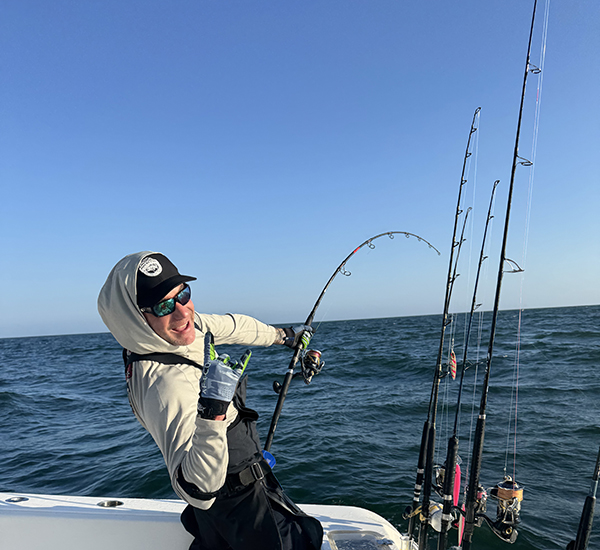
“For sheer excitement, catching them on topwater plugs, poppers and sliders, is right up there,” Adrian mused. “But there’s something about catching my own live bait, menhaden (bunker) are the most prevalent around here, and then fishing them on big circle hooks. Feeling one get nervous at the approach of a striper and then seeing a big bass leaving a V wake as it zeroes on your bait before it inhales it just the best. Even hunting for bait and throwing the cast net is exciting and kids on my charters love watching the baitfish in the livewell as much as the actual fishing.”
Do you have any tips for finding and catching striped bass you can pass along to other anglers
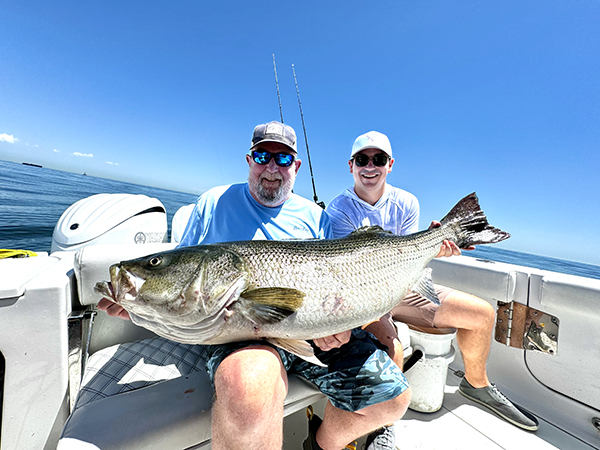
Adrian was full of suggestions that might help you catch stripers. He mentioned tides and fishing moving water but said he feels the best bite for big bass usually takes place on the change of the tide when the water is just starting to move. If you’re in a place where menhaden (bunker) are present stick it out for the tide change. He told us he is constantly looking for birds, not just flying and diving, but even those sitting on the water. A group of gulls and cormorants resting are usually on top of or near menhaden schools and with the help of your depthfinder you can get on the bait and bass. He recommends having a good pair of image stabilized binoculars so you can see birds and fish feeding on the surface up to two miles away. When fishing live bait, he always uses a bridle rig that incorporates a special tool and clips from a company called QuickRig® in Florida. The system increases bait longevity and improves hookup ratio. He said it is critical to take care of your live baits so they are healthy, have a good slime coat and will swim strong. His last recommendation is to keep a running log of your fishing trips because the information you collect this year can help put you on stripers in subsequent years.
What is your most memorable fishing trip?
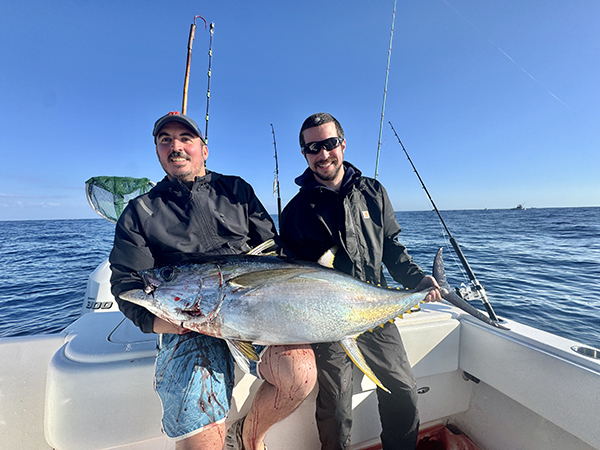
“For stripers, winning last year’s Manhattan Cup with my friend Mike Dean catching a 60-pound bass is the highlight of my charter fishing career,” Adrian recalled. That fish was the largest bass ever caught in a striper tournament and like all the fish in that event, was released alive and in good condition. “I’ve donated my boat and services to the Cup for the past few years and love the way it benefits veterans. I also want to thank Yamaha for being the major sponsor of the event. But I had another trip this past year that will be with me for the rest of my life. My son is 18 and recently went off to college. When he was young, we rarely fished together and only on the bay because he suffered from seasickness. I never pushed him to go more often, but this summer he asked if I would take him tuna fishing on the Contender. I was surprised, but very happy and hoped for the best. He got over his seasickness and on one trip we got into an amazing bite of yellowfin and bluefin tuna on surface plugs and he fought fish after fish. We were both grinning from ear-to-ear. I’m getting goose bumps just telling you about it.
Adrian Moeller is a great captain, angler, teacher and human being. Just ask anyone who has fished with him. He can be reached at www.rockfishcharters.com. Y
Back to Blue Life
“Adrian Moeller, I live in Brooklyn, New York and recently purchased a second house on Long Island. I was born in Germany where I was introduced to fishing in freshwater by relatives. I moved to Washington, DC with my mother at seven years of age and went to college in NYC where I started chasing stripers initially from the surf.”
Are you a charter captain or private boat angler?
With a successful career in outdoor advertising under his belt, Adrian purchased his first boat and chasing stripers became a major force in his life. He earned his captain’s license and took over Rockfish Charters some years later. Rockfish is one of only a handful of charter boats based in the city. His reputation as a captain has been on a meteoric rise due to his knowledge and ability to put anglers on stripers, but also due to his good-natured attitude and sincere desire to have everyone who boards his boat have a great time.
What is your current boat and power?
Adrian recently purchased a 39’ Contender powered by triple Yamaha F300 outboards that replaced his Sportsman 352 center console, also powered with triple Yamaha F300 outboards.
Have you owned other boats in the past?
Adrian owned ten boats prior to the Contender. “My last five boats have had Yamaha’s F300 outboards and with just regular maintenance even with as hard as I run them and the hours I rack up, they have all been bullet proof,” he told us. “When I get on my boat in the morning, whether it’s for a charter or fun fishing with my family and friends, my engines have to run, and my Yamaha’s have been totally dependable. The F300 is a workhorse, quiet, smooth, and fuel efficient. I am definitely a fan.” After completing the 2025 fall season he will be repowering the Contender with a set of Yamaha’s new F350’s.
How long have you been fishing for striped bass?
“I’ve been fishing for stripers for over 25 years,” Moeller said. “I started fishing for striped bass initially from the surf, and as my career in outdoor advertising took off, I purchased my first boat.” With that, learning the ways of the striped bass became a driving force in his life and he is more jazzed by it every year.
What do you consider your home waters for striped bass?
“I’ve lived in Brooklyn for many years and run my boats from a dock located near my house so the Hudson and East Rivers, NY Harbor, Raritan and Jamaica bays are my home waters. This area is right in the middle of what is a major spawning and nursery area for stripers,” he says. “It seems the fishing just keeps getting better, at least in this area. We catch more big bass each year, forty and fifty pounders, but there are stripers of all sizes from small young fish on up. It’s a great time to be alive and a great place to fish for stripers.”
What is your favorite way to fish for striped bass?
“For sheer excitement, catching them on topwater plugs, poppers and sliders, is right up there,” Adrian mused. “But there’s something about catching my own live bait, menhaden (bunker) are the most prevalent around here, and then fishing them on big circle hooks. Feeling one get nervous at the approach of a striper and then seeing a big bass leaving a V wake as it zeroes on your bait before it inhales it just the best. Even hunting for bait and throwing the cast net is exciting and kids on my charters love watching the baitfish in the livewell as much as the actual fishing.”
Do you have any tips for finding and catching striped bass you can pass along to other anglers
Adrian was full of suggestions that might help you catch stripers. He mentioned tides and fishing moving water but said he feels the best bite for big bass usually takes place on the change of the tide when the water is just starting to move. If you’re in a place where menhaden (bunker) are present stick it out for the tide change. He told us he is constantly looking for birds, not just flying and diving, but even those sitting on the water. A group of gulls and cormorants resting are usually on top of or near menhaden schools and with the help of your depthfinder you can get on the bait and bass. He recommends having a good pair of image stabilized binoculars so you can see birds and fish feeding on the surface up to two miles away. When fishing live bait, he always uses a bridle rig that incorporates a special tool and clips from a company called QuickRig® in Florida. The system increases bait longevity and improves hookup ratio. He said it is critical to take care of your live baits so they are healthy, have a good slime coat and will swim strong. His last recommendation is to keep a running log of your fishing trips because the information you collect this year can help put you on stripers in subsequent years.
What is your most memorable fishing trip?
“For stripers, winning last year’s Manhattan Cup with my friend Mike Dean catching a 60-pound bass is the highlight of my charter fishing career,” Adrian recalled. That fish was the largest bass ever caught in a striper tournament and like all the fish in that event, was released alive and in good condition. “I’ve donated my boat and services to the Cup for the past few years and love the way it benefits veterans. I also want to thank Yamaha for being the major sponsor of the event. But I had another trip this past year that will be with me for the rest of my life. My son is 18 and recently went off to college. When he was young, we rarely fished together and only on the bay because he suffered from seasickness. I never pushed him to go more often, but this summer he asked if I would take him tuna fishing on the Contender. I was surprised, but very happy and hoped for the best. He got over his seasickness and on one trip we got into an amazing bite of yellowfin and bluefin tuna on surface plugs and he fought fish after fish. We were both grinning from ear-to-ear. I’m getting goose bumps just telling you about it.
Adrian Moeller is a great captain, angler, teacher and human being. Just ask anyone who has fished with him. He can be reached at www.rockfishcharters.com. Y
Back to Blue Life